Way back in 1990 my family moved from the middle of nowhere North Dakota to a Seattle suburb. I grew up there and then went to college in Minnesota where I ended up settling down. Of course there have been trips to Seattle to visit family, but this marks the first time I’ve come back home without family being the impetus.
For those who haven’t heard of it, AWP (Association of Writers & Writing Programs) holds a conference each year and each year a different city hosts it. This year it happens to be in Seattle and so of course I’ll have to work in some family time too (I’ve a new niece not even three months old to see).
AWP has two main parts: the conference, stuffed full of so many panels you’ll never be able to attend all the ones you want, and the book fair, is “the nation’s largest marketplace for independent literary presses and journals, creative writing programs, writing conferences and centers, and literary arts organizations” that’ll blow every other book fair you’ve been to out of the water. In particular I’ll be searching out the Hamline MFA as well as the Great Weather for Media booths as I’ve got a vested interest in each of them.
As for the panels, hopefully my brain doesn’t explode. Here’s the crazy list of sessions I’ll be attending:
Writing about Culture and Place: Techniques for Vibrant and Ethical Worldbuilding
Reading at 24 Frames Per Second: Exploring Cinematic Influence on Literature
Demystifying the Application: Fellowships, Residencies, and Grants
Minding the Gaps and Mining Landscape in Linked Short Story Collections
How to Craft Enthralling Science Stories
The Sentence Is the Story: Reading, Writing, and Revising for Style and Sound
Nine Memorable Moments: Constructing Compelling Characters for the Screen
Filling in the Gaps: Folklore as Antidote to Forgetting
The Twenty-First Century Horror Novel
The Twist: Plot Turns That Make Movie Magic
Conjuring Thisness in Fiction: The Palpable Art of the Particular
Giving Helpful Feedback
Breaking Up with Shame: Writing Romance for Young Adults
Writing the Monster
Playwriting 101: Accessing Emotional Honesty in Storytelling
As you can see there’s quite the variety there. Obviously I’m interested in speculative content, but there revision and business sessions as well because like it or not those are part of the game. I don’t know exactly what I’ll get out of each session, but I’ll be taking copious notes for both my writing friends as well as MFA classmates to spread all that I learn.
I’ll sign off for now (I’m writing in the the hotel room and need to head out to meet up with someone attending AWP), but if you happen to be at AWP give me a holler.
I write this at 1:37 PM and so greet you all with a good afternoon, and not in the Will Ferrell/Ryan Reynolds way (unless you deserve it). As of yesterday I finished the last of my research for revising my novel and it’s time to hold myself accountable and report in.
Previously I mentioned three things that stood out in steampunk: Transportation, Science/Magic, and Weirdness. The five books I’ve read since then reinforce those observations with the addition of one more: History.
It just so happened that the books I previously read weren’t indicative of the Victorian locales commonly found in the genre. Of the five I just finished, all but Boneshaker were based in London. For me, this won’t play too much into the writing as my story takes place in a completelyfictitious world, but I do still want to talk about the setting and the history of it.
As a Theatre Arts and English major, I had plenty of exposure to British writers, and of course Britain played a major role in global politics (I’m using that term very loosely as I don’t want to fall down the rabbit hole of colonialism). With that, there is a lot of opportunity in period pieces for authors to embrace or tweak history and historical figures for the sake of the narrative and the world they’re inventing/adapting.
I particularly enjoyed how this played out in The Anubis Gates. The protagonist is a literary scholar who is an expert in Coleridge. It’s a time travel book and I’m not ruining anything by saying those characters meet. But that’s not where the literary and historical connections end. Many real-life persons are introduced and historical events help shape the narrative journey. I found myself wondering how much of what I was reading was factual (I knew some parts definitely were) and how much was invented. The fact that there were parts I was unsure of made it that much more engaging.
The Difference Engine was much more liberal with its treatment of historical figures and events, enough that I could lump it into the alternate history genre. But in staying true with the setting and technological advancements it solidly fits with the rest of the steampunk I’ve shoved into my brain the last couple of months. Boneshaker too did this, though in Seattle instead of London. As someone who grew up just south of Seattle I found that personally engaging as well. The author made a point at the end of the book to acknowledge what liberties she took with historical accuracy, giving a look into the massive amount of research that goes into period pieces.
As I pivot from reading to re-writing (and starting up grad school again on Monday), I’ve got not only a stronger idea of the genre that I’m piggybacking off of, but a much better handle of genre expectations, both to adhere to and to subvert. Whereas I was initially really trying to scientifically explain how the technology works in my story, I’ve learned that a lot of that can be hand waved away. Brandon Sanderson used an iceberg metaphor regarding world building that I think can be co-opted for this. He (paraphrasing) said that if you have enough surface level complexity, the reader will assume the unspoken parts of the world are known to the author and also have legitimate explanations/reasons. That works with the technology of steampunk. It’s basically magic, but as long as it’s explained in part, the rest is assumed to work as well.
That’s all I have for today. I try not to make these too long, though if you ask my wife I could go on about these books at some length. I’m starting a class focusing on point of view on Monday, so between that and rewrites my brain is going to be working overtime for the foreseeable future. Enjoy the weekend and I’ll try to have another post soon.
Merry Christmas and Happy Holidays. Most people in the world don’t celebrate Christmas, and far fewer celebrate it in a religious fashion. I celebrate it in a benevolent commercial way. I don’t believe in a higher power, but I do enjoy the opportunity to be with friends and family and the exchanging of gifts in the process.
My wife and I alternate which family we visit each year and this year we went to Seattle (where I grew up) to visit my family. We rented an airbnb and had over 20 people under one roof. That being said, any hopes I had of writing or continuing my reading goals were thoroughly dashed, and the only productive time I had was on the plane where I managed to get through about two thirds of Boneshaker while helping to manage our four-year-old and his airplane-bathroom-shy-bladder problems. There were a lot of trips to that bathroom.
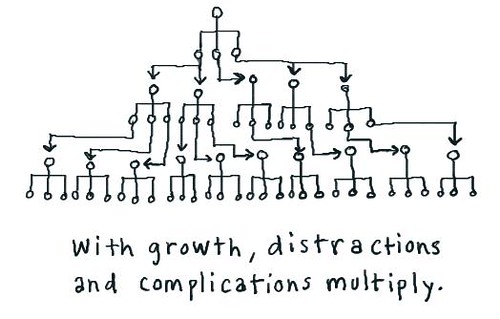
This delay in productivity however gave me the idea of what to write about today. Distractions.
I’ll be the first to admit that my main distraction is my phone. Facebook, mobile games, internet rabbit holes, they’re all regular culprits for my lost hours. For a while I was actively playing far too many games: Disney Emoji Blitz, Hero Wars, and Clash Royale being the main culprits. In October I cut myself off from all games except Clash, which was to be my kill-five-minutes-game as opposed to a regularly played thing. The idea was I’d have more time to write and work.
That didn’t exactly go as planned. I did cut out all but Clash, but still play it a bit more than planned. The upside is I did get more writing done and I have larger chunks of time for reading. So distractions reduced, but not eliminated.
The next distraction I want to mention is TV/movies. I’m a huge cinephile. It’s got to the point when I make references in my friend group that I just assume no one will get them and usually that’s what happens. With my kid around I watch much less than I did before since he needs attention and I can’t exactly put John Wick on in the background. That means once he’s asleep I’m much more motivated to catch up on a show or movie I’m behind on than to be productive.
Practically speaking, I wouldn’t be able to write if I wanted to. He’s asleep at 8:00 and my brain has checked out for anything more than entertainment input. A book is entirely feasible, but more often than not the TV gets powered on, the hum of Netflix triggering those endorphins. I haven’t found a good way around this distraction. There are too many interesting shows and movies out there to watch them all, so I do what I can.
The last real distraction I struggle with, and I challenge any writer to deny their struggle as well, is the new idea. No matter the project, something you write or see or dream will inspire and drag your thoughts to something new, something unconnected with what you’re trying to complete. For me it’s usually dream based as that’s where most of the kernels of my ideas come from, but this distraction can come from anywhere.
My current distraction came from a dream and is a murder mystery. The dream played out like watching a movie, the roles featuring well known actors playing characters and I was the viewer following the drama and intrigue. But before I witness the resolution I woke and was left with a legit “whodunit” thought. And so for a couple days I completely forgot about my novel and my reading and thought about this new story.
I don’t want to give much away in case I do write this at some point, but Tom Cruise was killed, and Hailee Steinfeld was Nancy Drew-ing her way through suspects to figure out who did the deed. Alongside those two were Jack Black, Delroy Lindo, Helen Mirren, Stanley Tucci, Eugene Cordero, Ben Mendelsohn, and Timothee Chalamet among others. But based on what I’d seen in the dream and what my detective fiction knowledge told me to do I’ve now figured out the killer(s), motives, and opportunities. I’ve also assigned backstories to each character as well as each set of characters. There’s no reason two suspects might not be at odds with each other as well as with the deceased.
This distraction was particularly hard to ignore given my fondness for the genre. My senior thesis was on detective fiction, specifically Walter Mosley’s Easy Rawlins stories. I’ve a list of mystery plots already on file and I try to watch them whenever I can (I just watched Glass Onion which was good in presentation but sad in that there are visual tactics that just don’t translate to the written word, and I recently rewatched Dead Men Don’t Wear Plaid, which if you’re an old noir movie fan you must give it a watch).
While I was victim to this distraction, I was able to limit it. I had to scratch the itch, that was a given. But once the itch was scratched, I couldn’t just leave it alone. So, like so many other ideas, it went to the idea notebook.
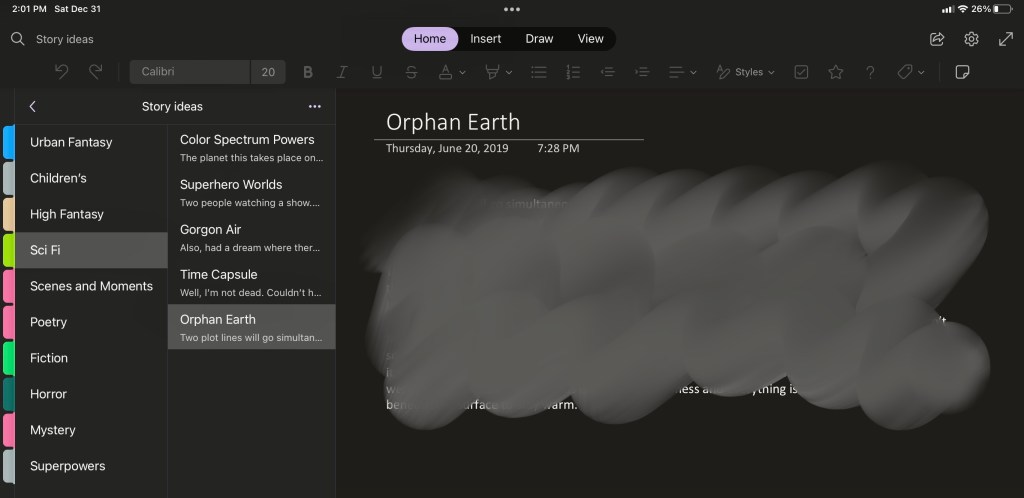
My notebook is digital so I can access it on any device, but any notebook will do. I use OneNote since it’s very good at simple organization and the interface is very user friendly. Once I have a story idea, whether it’s an inkling or more fleshed out, it goes there until I’m done with my current project. It’s a great way to group ideas, not just to write later, but sometimes to combine and weave together. A good story doesn’t have just one through line to engage the reader, but many smaller stories told in conjunction. By grouping ideas together in one place or side by side, many complimentary ideas can be combined that may have otherwise been overlooked.
I see that I’ve derailed somewhat from my topic of distractions. But isn’t that was a distraction is? Our minds inherently want to discover, to learn or experience something new. And we need that for creative growth, for those subconscious influences and at times the more overt ones. So is my advice to cut out all distractions? No. Just limit them. Find out what distractions are beneficial to your craft (Glass Onion) and what ones are less so (Emoji Blitz). Embrace your distractions, but do so on your terms, not theirs.
Reading research progress: Four books down in just over a week.
To get ready for my first round of edits on my novel, which I’ve been describing as steampunk adjacent in regards to genre, I felt I should read a bunch of steampunk books both to find pitfalls to avoid as well as potentially gain inspiration for new/revised content. Since my last post just over a week ago I finished The Lost Metal, The Brothers War, The Steampunk Trilogy, and The Aeronaut’s Windlass. The last two are proper steampunk. The first has qualities for sure, and the second was more of a filler book while I waited for the actual ones to arrive from the library. It too though had steampunk facets to it. Now, what was gained from over 1000 pages of genre-focused reading?
Observation 1: Transportation
Most readers know about the stereotypical airship trope in steampunk. Both The Lost Metal and Aeronaut’s Windlass had them, though the importance of each was drastically different. The Steampunk Trilogy had a nuclear powered train (for a page and a half), and even The Brothers War had flying ships of a sort.
Now I know transportation is integral to movement for most characters in most stories, but steampunk really integrates it into the story and the world itself. With such fantastical devices for their era, steampunk’s modes of transportation are a wonder and a backbone of the genre. And the fantastical thing about them? That’s observation 2.
Observation 2: Science! Or, magic. Or something…
I’m only four books in, so we’ll see how long this holds up, but it seems like in steampunk when you want something cool to exist/happen, just make up a reason for its existence. The Brothers War had powerstones and The Aeronaut’s Windlass had crystals. Both provided power and were essentially batteries in a world that didn’t have power otherwise. The Lost Metal, not strictly steampunk, used magic for their airships, and the most ridiculous of all, in the third story in the Steampunk Trilogy, a seeress’ lactation was used to transport a ship to purgatory (it’s a little more complication than that, but still very weird).
Excluding the trilogy, the science/magic/something that powered their technology was also intrinsically entwined in the culture and the world of the story. If a random thing just existed for the sake of coolness, it would seem like a cheat, but for these stories there is a function that not only allows the coolness to exist, but also colors the actions of the characters and the society.
My initial thought when starting my first draft was that I wanted to make everything theoretically possible. That somewhat went out the window in the prologue, but about halfway through I really pivoted from our reality to the reality of the world I was creating. These stories have definitely shown me how much that diversion is useful and needed in the genre.
Observation 3: Weirdness
The winner here for weirdness is The Steampunk Trilogy. When I was first looking up books to read the warning for this one was that it was weird. It is. So very, very weird. But it wasn’t the only one. Lost Metal has shapeshifting immortals. Brothers War has extradimensional techno-demons. Aeronaut’s Windlass has talking cats and hippo-sized spider-things. Weird.
While they were all weird, they were all enjoyable too. It seems that weird is just part of the genre. In my story I don’t have anything like that. At least not yet. Knowing the precedent is there allows for some creative storytelling. Or not. It’s not like these are exact standards to be followed.
Conclusion:
Of the books, I felt the strongest were The Lost Metal and The Aeronaut’s Windlass. These not only had much better characterizations, but their technologies were integrated into their world in a grander and more seamless way. They presented not only compelling stories, something I believe to be paramount no matter the genre, but a world wholly unique and engaging.
My main takeaways from the readings revolved around technology integration as well as being able to distance myself from the realistic function of that technology. Of course there should still be rules for the technology, but those rules don’t have to obey the same laws of physics that we do. Already I’ve ideas for expanding current concepts as well as a few new ones.
So it’s been a while since my last post… I’ve got to try and make this more of a habitual thing. Whenever I forget to do something my wife asks what the point of the fancy Apple Watch on wrist is if I can’t even set reminders. We’ll see how this goes.
But for the exciting news bring me back: I finished the first draft of my novel yesterday. Yes, nine months into it (with breaks for childcare in the summer and from a literally break of my arm) I’ve finished the draft.
Without giving too much away, the genre is something that I’ve never seen done before, nor have people I’ve talked about it with. That being said, my next step is to read a bunch of genre adjacent books before my re-write. Hopefully I’ll see fun strategies as well as things to avoid.




 Eric Taveren