
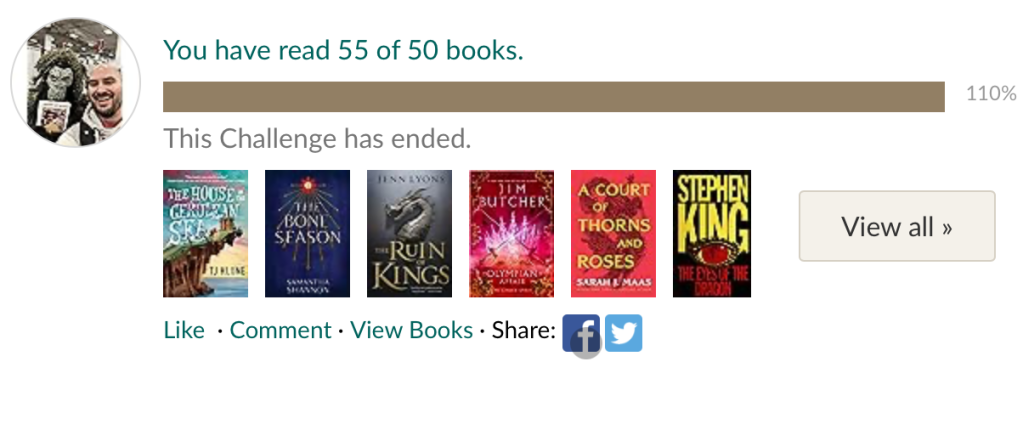
I finished up 2023 with 55 books read, beating my Goodreads challenge by five books. Averaging just over a book a week, it occurred to me that there is plenty of opportunity to talk about books and what I, and perhaps you, are reading.
The next thing I wanted to decide on was how to talk about the books and how to value them, as a review generally is supposed to do. How to talk about them was the tricky part, but after conversations on twitter as well as in real life, I’m going to pick something from the book that either stood out as effective or ineffective, and do a spoiler-free analysis of that particular literary technique (because everyone hates spoilers).
Valuing the book seems trickier. You can find a something-out-of-five rating on Goodreads easily enough, but I wanted something more personal, and something more informational. What does a star mean? What’s the difference between three and four? Between four and five? Did the fantasy have too little magic? Was the romance too overt? Did I figure out the mystery’s killer in the first ten pages? I read a lot of different stuff, so I need something that can accommodate different types of books. I hereby give you…
The Author’s Arsenal system.

By no means are these five areas exhaustive, but they represent five key elements in any story. By not awarding a book with one of these emblems, it doesn’t necessarily mean it did poorly (though it very well could). Instead the emblems it does receive should be lauded as the book’s strength. The five emblems are:
 The Quill Pen. This will be awarded for exceptional storytelling or narrative.
 The Inkwell. For depth and richness of theme.
 The Parchment: For the quality of writing style and prose.
 The Seal. For character development.
 The Scroll. For world-building and setting.
So, without further ado: The House in the Cerulean Sea.

T.J. Klune’s magical realism novel treads the line between middle grade and YA. It’s longer than a typical middle grade book, however the language fits a middle grade book style much more closely than it does YA. The prose is direct, the characters are clear with their feelings, and everything feels very honest.
As I finished my read, two things stood out. First, the world-building. The House in the Cerulean Sea features an alternate version of our world where magical creatures/children exist and are known by the general populace. Linus, our main protagonist, is sort of a social worker for these children, and the whole story revolves around a specific assignment he must complete.
From the inner-workings of the bureaucratic government oversight agency to the prejudice of humans toward magical children to the intricacies of the various environments, Klune does a great job of establishing a believable world the characters exist in. Often times middle grade stories can gloss over details or dive too deep at the expense of narrative and character, but he does a fine job of maintaining the correct balance.
The second highlight is theme. It is established early on—so I don’t consider this a spoiler—that Linus is a gay man. There’s no fanfare in the revelation, and no shame. It is was it is. Which is exactly how it should be. Linus exists in a world where he expects to be treated the same as everyone else, and believes that others have the same right. Including magical children. Between him wrestling with his own emotions as well as understanding and accepting the children, Klune does a fantastic job of establishing and reinforcing a positive theme with enough tact and honesty for a middle-grade (and older) audience to understand the message without feeling they are being beaten over the head.
Before I move on to my craft bit, I do want to call out the one thing that rises above the rest in this book. Written as a middle grade book, there are expectations and limitations when it comes to prose. A third grader typically won’t be able to handle Tolstoy or Faulkner. The prose must accommodate the audience. But that isn’t necessarily a summation of the author’s ability. While most of the book reads as typical middle grade prose, there is a poem around the midway point that, while plain in diction, is rich in metaphor and layered with emotion. After I finished it I audibly said “dang.” If you pick up this book, that is definitely something to look forward to.
On to craft. Since finishing this book, I’ve had many discussions about it, some with people who haven’t read it (mainly on the function of craft), and some who have (mainly on the application of craft). Based on those conversations, today’s topic is agency.
I’m sure most of us are familiar with the term, but agency basically describes the character’s ability to do something. Are they reacting to events and being led by the nose, or are their reactions to the events of the story their own choice, plot and antagonists be damned. There is a distinction to be made about their choice.
If the character gets into a situation where they must do something or face terrible consequences, sure, they’re technically choosing to do the thing, but that’s not much of a choice. They’re basically being herded. But, if they’re presented with that same choice and do a third option, or they agree and turn that choice into their own growth, then you’ve got some agency.
Sometimes the decisions are small. Deciding not to answer that phone. Turning left when they always turn right. Maybe this one time they’ll skip the coffee shop on the way to work. Sometimes the decisions are larger. Standing up to the bully. Giving into temptation and stealing that heirloom. Turning off the targeting system as they fly through the trench.
What makes characters interesting is their choices, and their ability to choose. It makes their lives more dynamic, makes their actions carry more weight, and it adds a pulse to the story, an energy the reader can feel even if they’re unaware that’s what they’re feeling. You can have an amazing plot and setting, but if you have a boring character sleepwalking through that story your readers won’t connect.
In The House in the Cerulean Sea, Klune uses a tried and true character arc of a person lacking agency, only to gain it as the story advances. That arc can be tricky. If you wait too long to have the character begin to learn, you may lose your reader. Often times those characters will be supported by interesting plot, immersive world-building, or engaging prose. If you can hook the reader long enough to ascend that arc, then good on you. But without a character to invest in, pretty words and locations can only do so much.
And now, for the big moment, how did The House in the Cerulean Sea fare with the Author’s Arsenal?
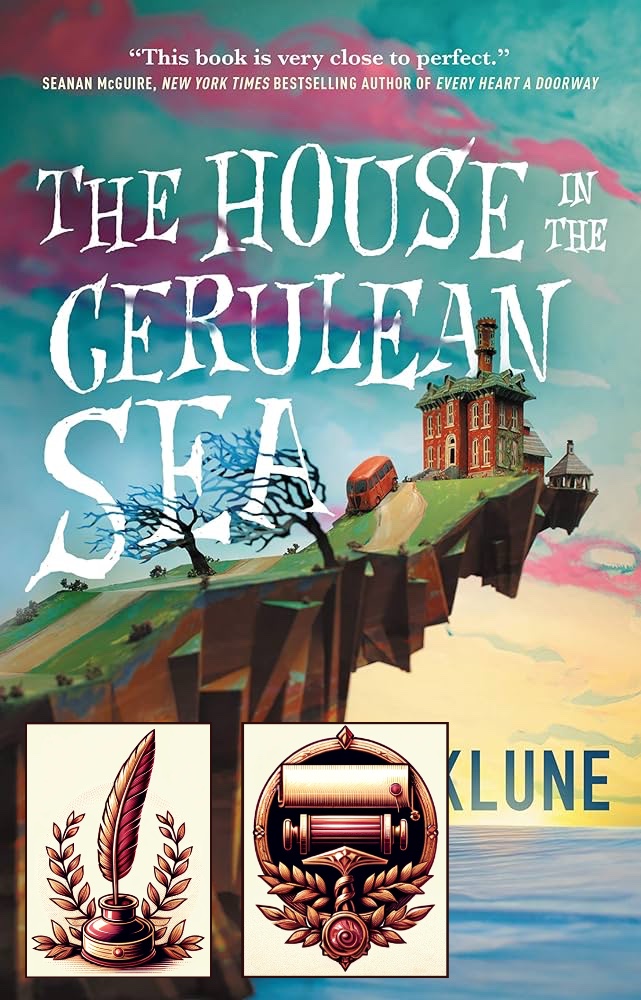
For deftness of theme and a well-execute message, especially given the audience age, I award The Inkwell. For an immersive (and wholly believable) world, I award The Scroll.
Remember, for awards not received, it doesn’t indicate a poor execution of those qualities. The awarded emblems are just for what is done particularly well.
I’m sure this is the most prestigious award the book has received ;) As such, Klune should be proud of the world, characters, and story he created.
Future reviews won’t have the whole explanation of the review process. This one did because it was the Arsenal’s maiden voyage. Expect a variety of books, new and old, across genres. And, if you have any you’d like to recommend, let me know. If I’ve already read the book, the odds are low I’ll review it. I rarely re-read anything because there’s just so much out there and I want to get as much new content as possible.



 Eric Taveren