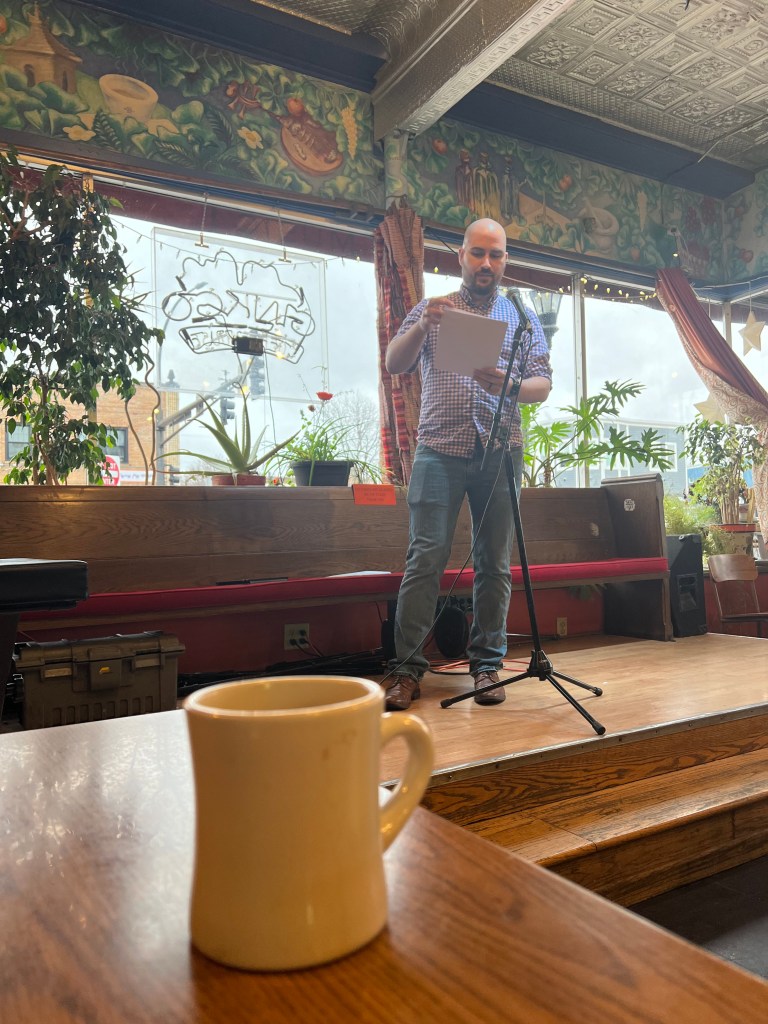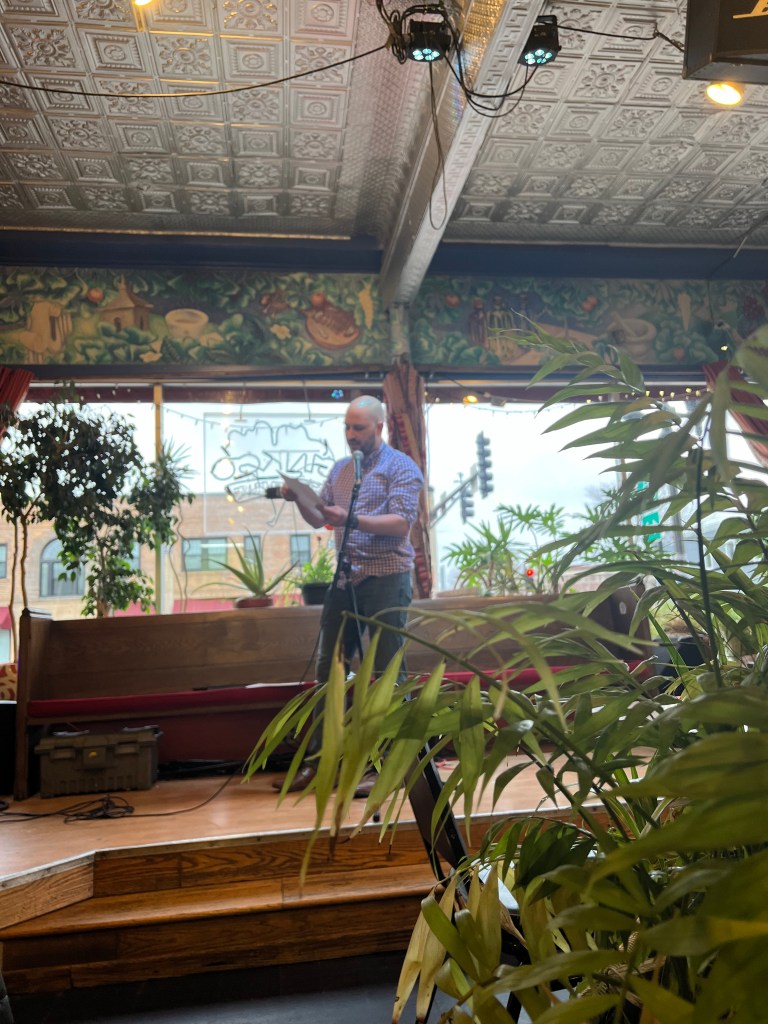
A few weeks ago I did a reading at a coffee shop that got me thinking about public speaking. Or, more specifically, public reading.
When I got on stage, in front of the mic, everything was fine. I introduced myself, totally off the cuff and not rehearsed. Then I started reading and remembered why I like to sit for stuff like this.
Halfway through my first piece, my right leg got a nervous jiggle, sort of like restless leg syndrome. I didn’t feel nervous, wasn’t stumbling over my words or anything. But the jiggle came, increasing nearly to the point of Yankee dancing.
This typical sign of nervousness is particularly strange because I have a theatre background. I’ve been in stage shows and have performed in front of much larger audiences than at that coffee shop, all with no leg jiggles.
So what’s the deal? I really have no idea. The reading went well. People laughed where they were supposed to, and the applause didn’t sound like merely polite clapping. But as I read through the three short pieces, that leg would not stop.
Eventually, to hide it (which apparently worked, based on what my fellow readers told me), I just put all my weight on that one leg, letting my mass stick it in place. The jiggling didn’t switch legs, but I could tell it was still there. By the time I got done though, my hip was not pleased about that stance.
So how do I fix this moving forward? Is it simple a matter of more practice? Maybe. Hopefully. Because without a conscious feeling of stage fright, I don’t have a good answer. The subconscious on the other hand… the subconscious is weird. It does what it wants.
The difference could stem from the fact that I was reading my own work (ignoring the fact I’ve written things that I’ve later acted out). The difference could also be that I didn’t view it as acting. That seems the most likely to me. Maybe I just need to pretend to be a reader, or the actual narrator of the piece. Act it out.
Regardless, that jiggle needs to go away. Not just for the sake of my hip, or the fact that I’d never Yankee dance (or Yankee anything). How about this: from now on, I’ll just insist on having a nice, padded leather chair. Sit down, cross my legs, and be at peace. Completely reasonable. It worked well enough in my kid’s kindergarten class. 🙂
It’s been a while (exactly twelve days) since I’ve written anything, be it here or on a project, and I can lay the blame solely on my wife. Okay, maybe not solely. I maaaay have had something to do with it. Regardless of blame, I’d like to introduce the newest distraction in my house, Kara.
What I’ve learned so far about her is she very strong, thinks sleeping is for the daytime, and gives a wicked side eye. We still like her anyway. 🙂
Just a quick post here: If anyone lives in or around the Twin Cities, VERS/ATILE is hosting a reading this Sunday at 6pm. There are featured readers, followed by open mic. I’m one of the featured readers and I’ll be reading a couple of published shorts as well as one scheduled for publication this fall. Sort of a sneak peak.
If you’re interested in attending, the reading will be at Gingko Coffeehouse on Snelling in St. Paul.
I should note that if my wife ends up having our baby on Sunday, I’ll probably not be there, but I’ll update this if that’s the case.
I’ve posted before about my love of Lego, and how I’ve decided this year to apply for Lego Masters once the applications open up. One of the application requirements is to give five examples of MOCs (My Own Creations) that you’re especially proud of. I never was in the habit of taking pics of what I built—I mainly played for fun—so that meant I needed to build five new creations, and I thought it’d be fun to share the design and build process of one of them here.
Also, for those who want a challenge, as you follow the steps, see if you can come up with a piece count guess. I’ll post it at the end.
The very first step in the design process is to figure out the general idea and story. Similar to when writing a book, no? 🙂
This one came from my kid. Most kids have a singular favorite color, especially when they’re younger. Westley’s favorite colors for years now have been pink, golden, silver, and rainbow. He’s also super into math and we’d been working with counting currency. So I decided to make a piggy bank that was also a rainbow.
Now, where do we see rainbows? Up in the sky, with the clouds. So bank, rainbow, clouds. I have a setting, and I have functionality and play (something I prioritize in my Lego builds). I see tons of amazing Lego builds which are super pretty and complex and crazy cool, but they are not meant to be touched. There’s definitely a place for that. I prefer through builds that are meant to be handled and interacted with. You play with Lego, right?
But now I needed to add a story. A rainbow on a cloud presents a nice visual, but why is it there? Because someone wants to turn the white cloud into rainbow colors, of course. Cause chaos! Be crazy! Just be careful you don’t step on that dropped piece while bare footed.
The final aspect, one I knew I wanted to try at some point across these builds, was a tensegrity element. For those unfamiliar with the terms (I was until recently), a tensegrity build uses tension to give the appearance of floating. As gravity pulls down, the tension of the strings resist and hold the object in place, pulling from different directions.
There’s a science to this, what with center of gravity, balance, equilibrium, and—spoilers—I probably should have thought hard about that early on.
Looking through my photos, I probably should have taking more pics throughout the process, but I’ll explain as best I can in chronological order. First up: the coin sorter and how to make a large, curved rainbow.
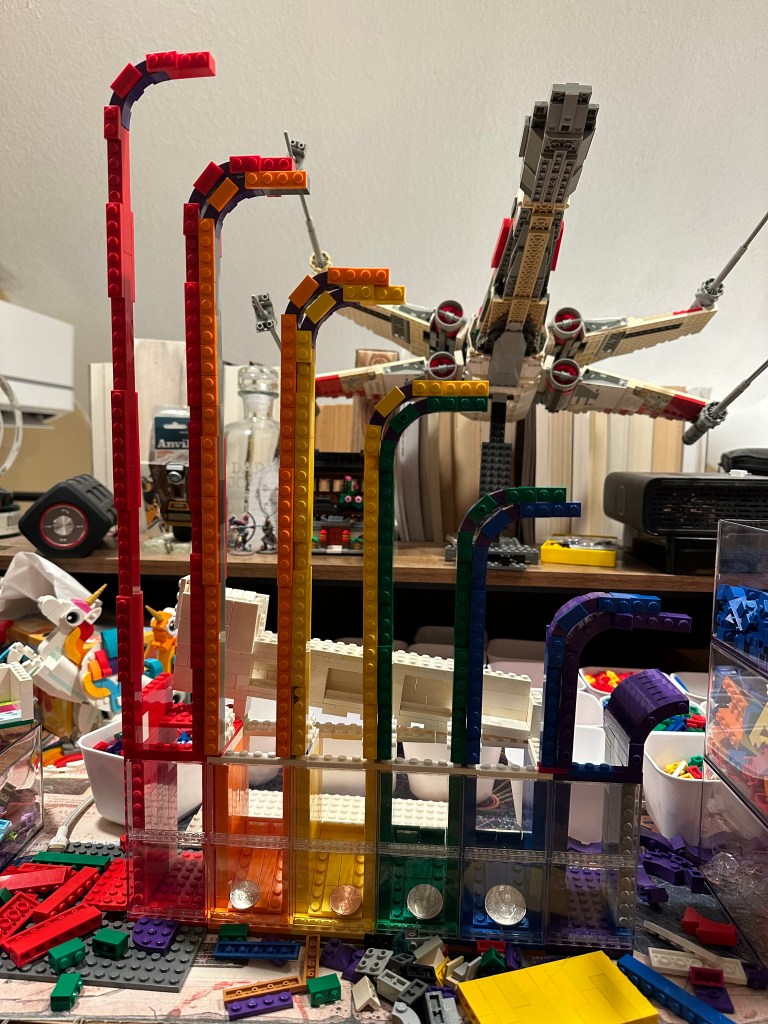
I didn’t take a picture of the whole coin sorter, but you can seen the end of it on the left. The white enclosure sits at an angle, creating a gentle slope, enough that the coins will roll but not so much that they’ll shoot past their respective exits. 1×2 wedges run from the beginning to the last section, tilting the coins so they lean toward the hole. This serves two functions: to aim the coin toward its hole (insert Happy Gilmore reference), and to create the proper elevation shift so the penny and nickel don’t fall out at the same spot.
To control where the coins fall out, I simply added a plate across the top of the hole, making the hole smaller and smaller as we went from nickel to penny to dime. And that’s all it took. And with four coins and six rainbow colors, it was easy to determine where to put the sorter.
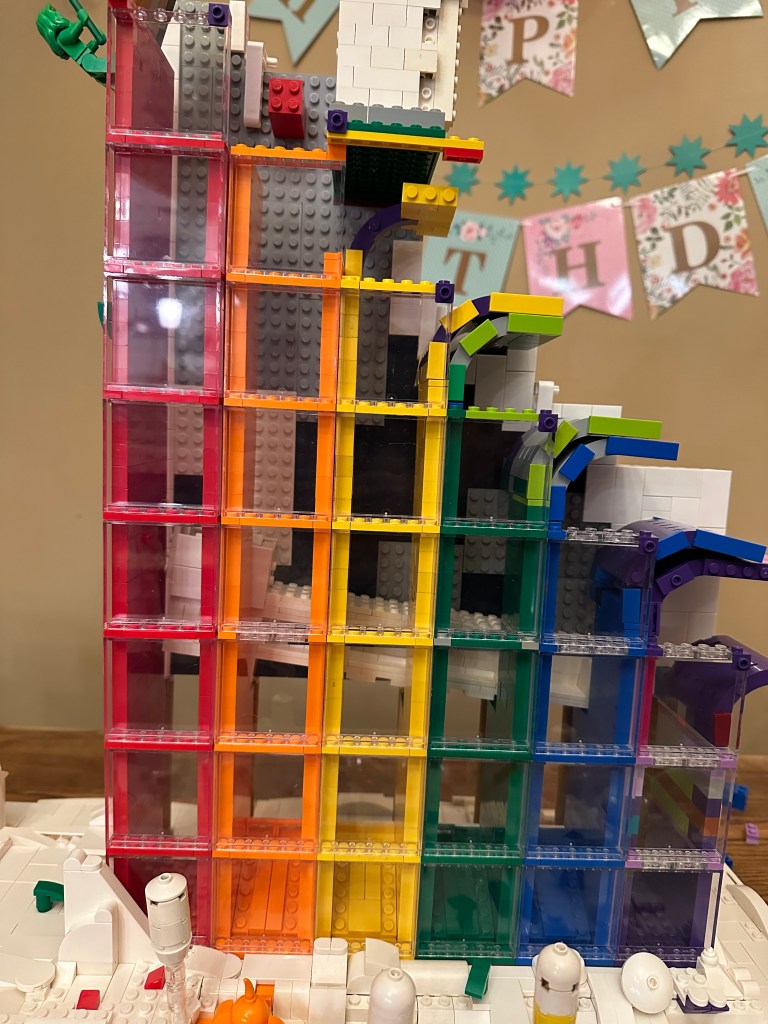
Figuring out how to make the curve on the rainbow was another matter entirely. I ended up going with something very similar to what you see above. I tried different sized curves and it soon became apparent that with the size of the build, I needed the large curve I could find. Also, you’d be surprised at to how few pieces exist in the six rainbow colors.
To connect the curved pieces (horizontally aligned) to the rest of the rainbow (vertically aligned) I added a row of 1×1 studs beneath the curves, with one of them being a technic brick with a hole in the middle. That hole attached to a singular stud in the middle of tile pieces, and that connection was firm enough to hold everything in place. Later on, once the backdrop was built, I also attached the curved to the backdrop for a few of the colors.
Here’s a better look at the coin sorter, but also the quasi-framed out rainbow. For the left colors I just used a row of bricks on their end to approximate the size. It ended up being A LOT taller than I was anticipating. About this same time I realized I had very few orange bricks, and next to no purple. Over 100000 Lego accrued over thirty years, and I had fewer than twenty purple bricks. Crazy.
The next step in the process was to figure out how I wanted to incorporate the tensegrity element. If the idea is that tensegrity gives the illusion of floating, what better to float than a cloud? But it couldn’t just be any cloud. There needed to be a reason.
This is the point where I should have considered the science of the tensegrity element, not just the coolness. I thought, you know, what if you dropped the coin on a floating cloud, which it’d roll down, then fall on another floating cloud, then plinko down to the sorter? Yeah. That’d be cool. So without additional thought, I started building.
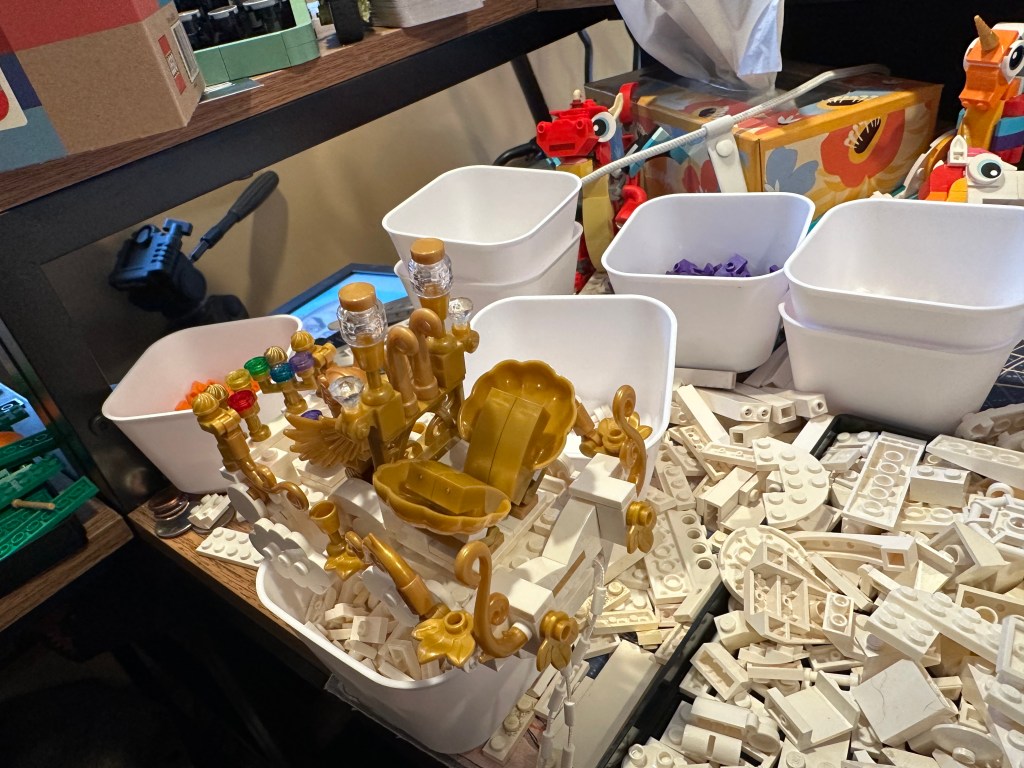
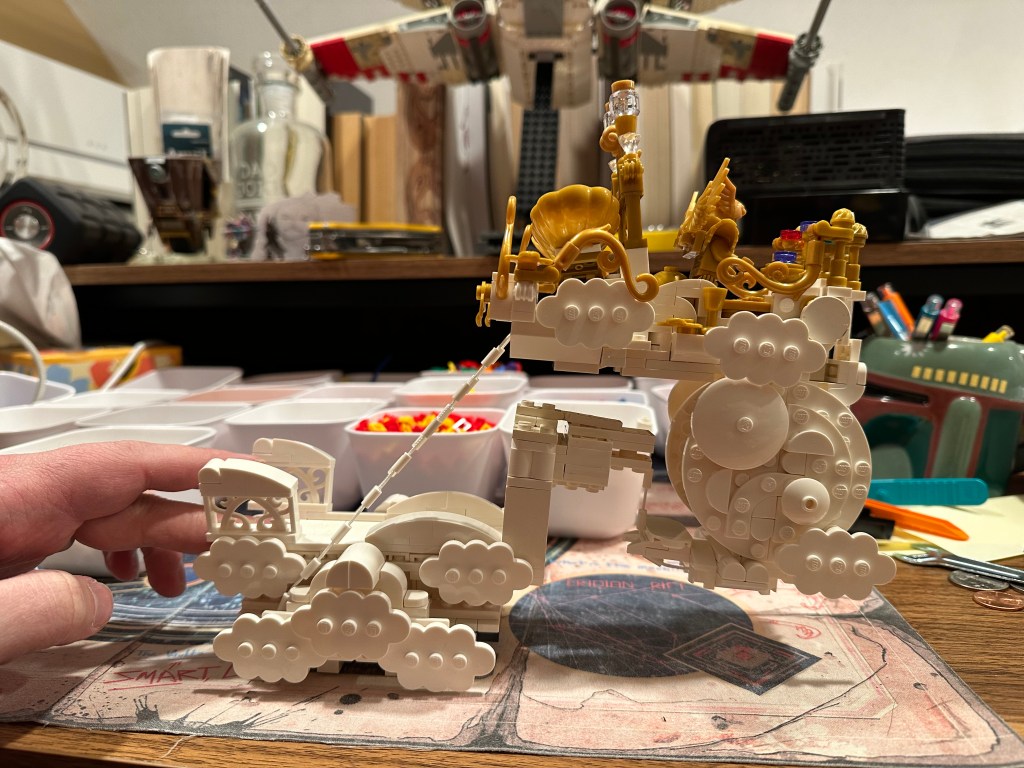
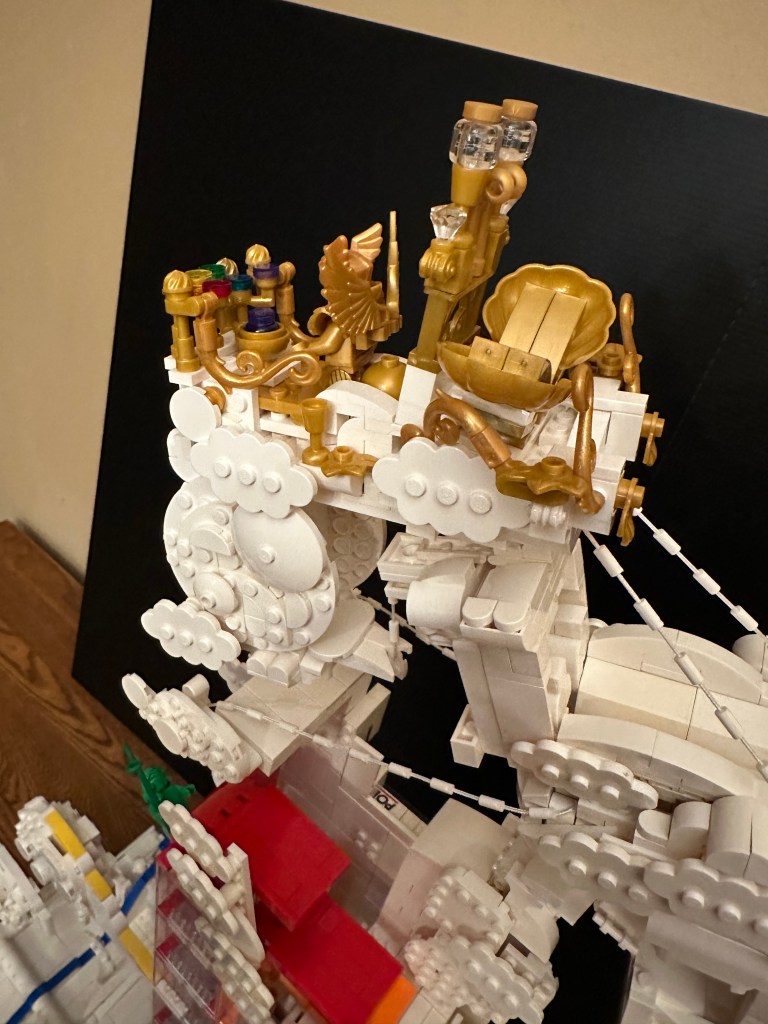
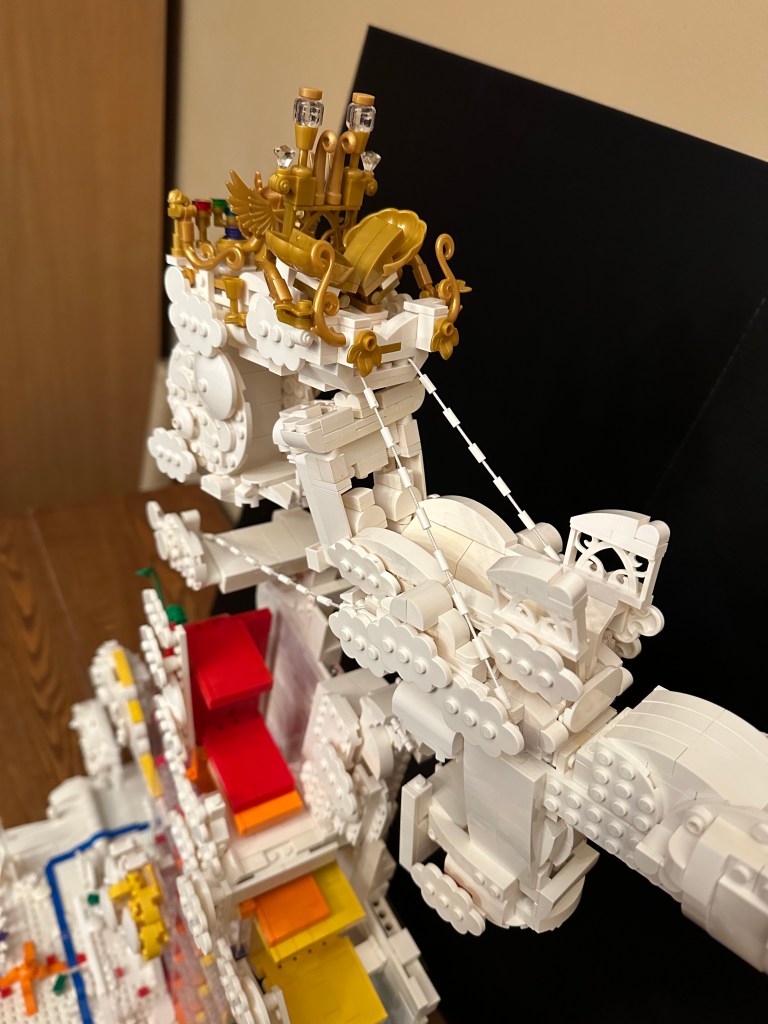
The basic idea for the story, is that this gold dude (since my kid loves gold) has decided to mess with the clouds and is unleashing the rainbow and its colors on the pristine white puffs. He’s got a supply of each color and a little cauldron to actively add a color. The clam shells behind him are where the coin will initially be set and will then roll off to the next cloud.
This was to be the highest elevation tensegrity element, and you can see on the bottom picture the string (Spider-Man’s webbing) hanging off the back. For this one, it wasn’t too hard to attach the string firmly, since there wasn’t a ton of weight. And now I needed some perspective.
I’ve talked on here before about having aphantasia, an inability to see images in my mind. Makes it hard to visualize a project without actually doing it. And by hard, I mean impossible. I have ideas and concepts that I can define or talk through, but until I start creating, there’s no way I can see what I’m planning. So it was time to throw things together.
A fair amount of what you see above functioned as placeholders. The “clouds” the white minifig was creating looked more like bubbles, the background was random plates, and the lower clouds looked more like mini water towers. But It allowed me to see what I working with.
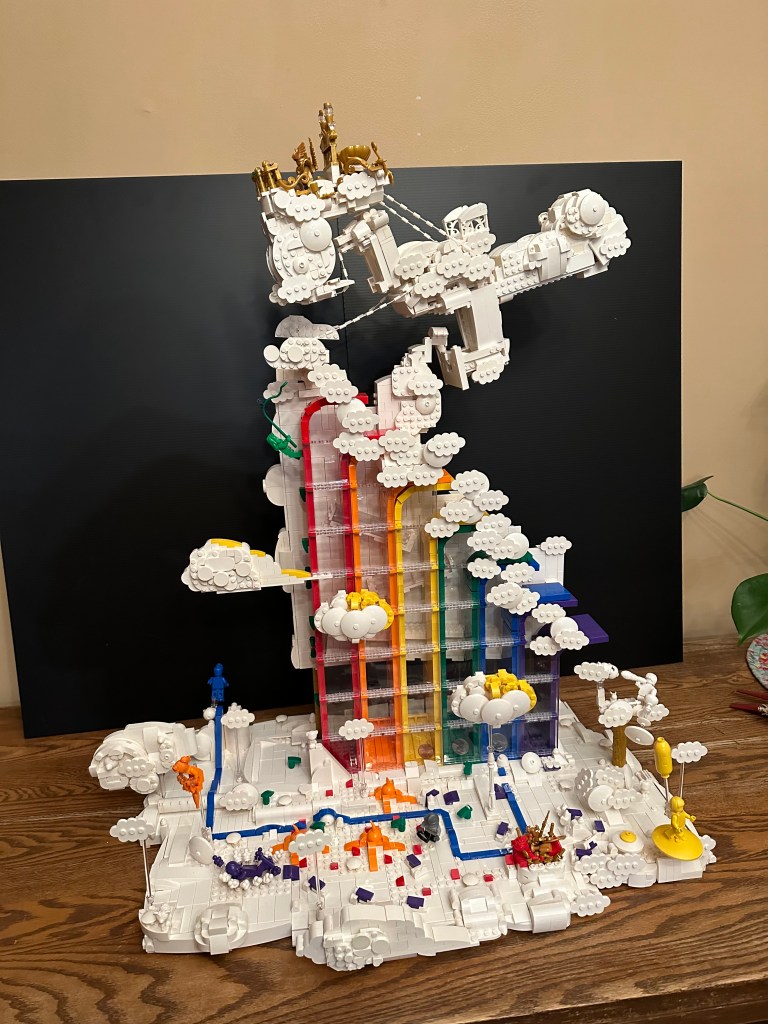
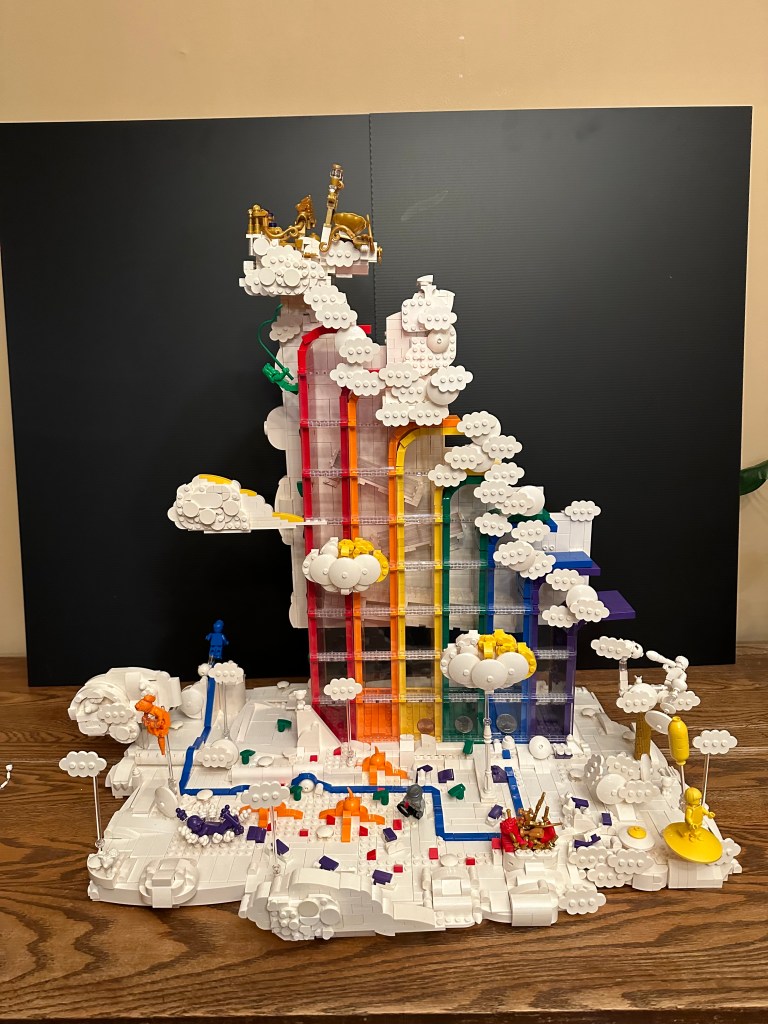
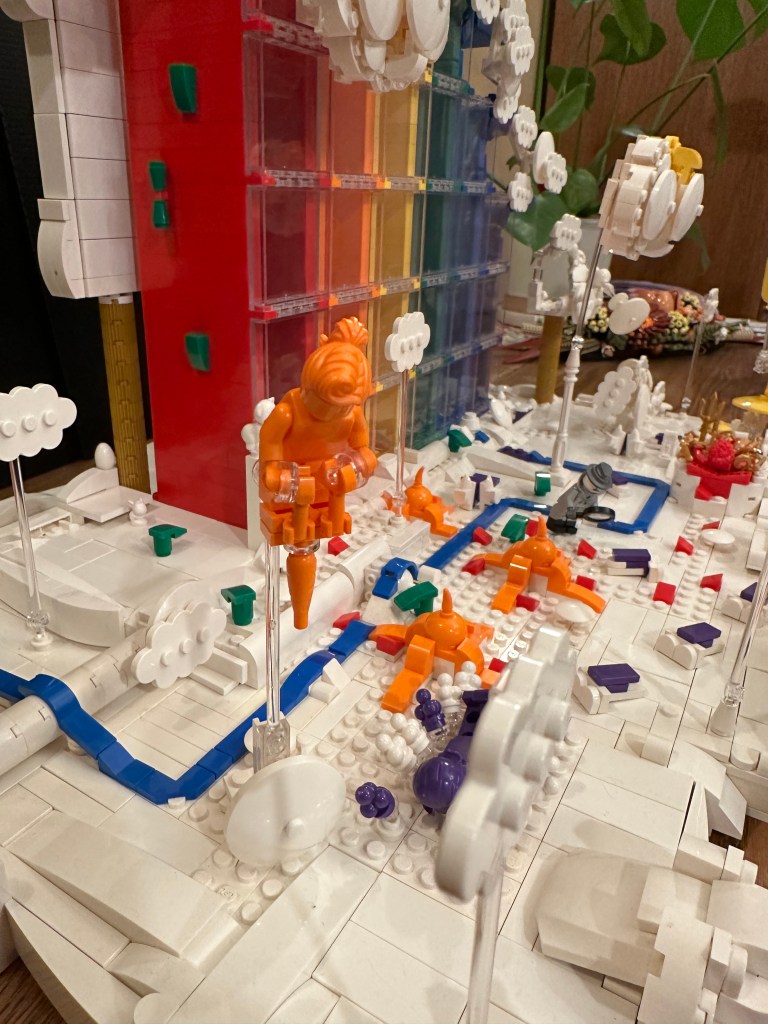
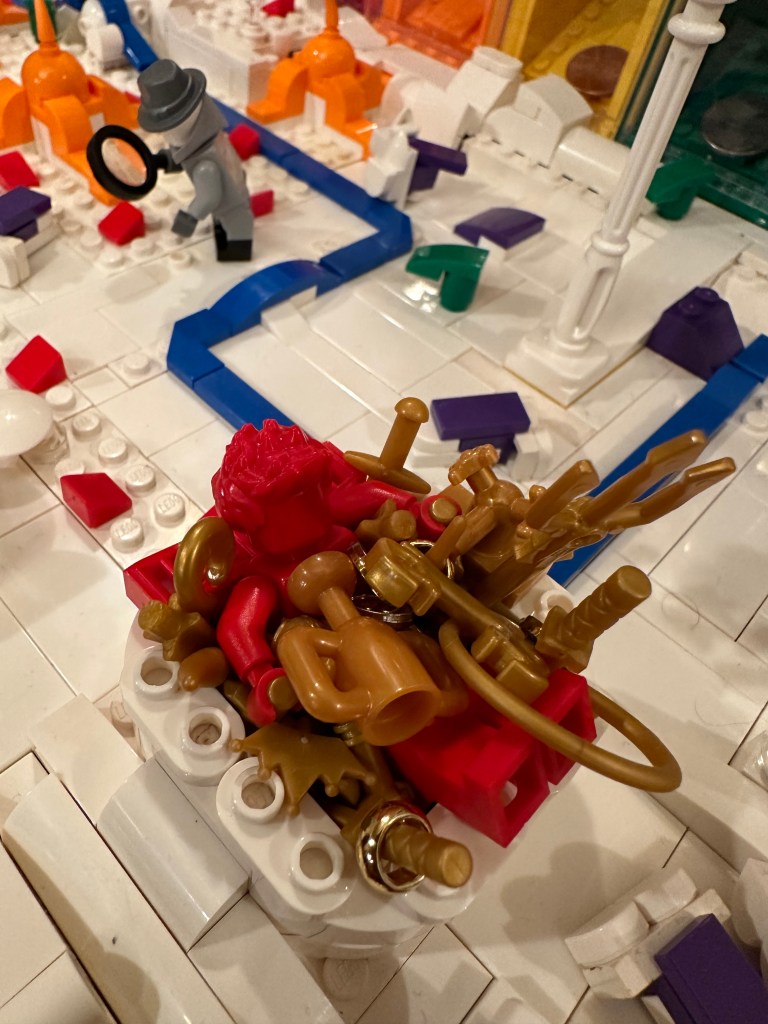
Each color had a minifig running rampant across the cloud, for which I needed a huge base in order to make it not too cluttered and busy. Red is bathing in the gold guy’s stuff, Orange is pogo sticking and leaving massive blotches of orange, Yellow is aimlessly wandering and staining the floating clouds yellow, Green is climbing the actual rainbow, Blue is skating out of control on a single skate, and Purple biffed it while skiing, making puffs of purple as she landed.
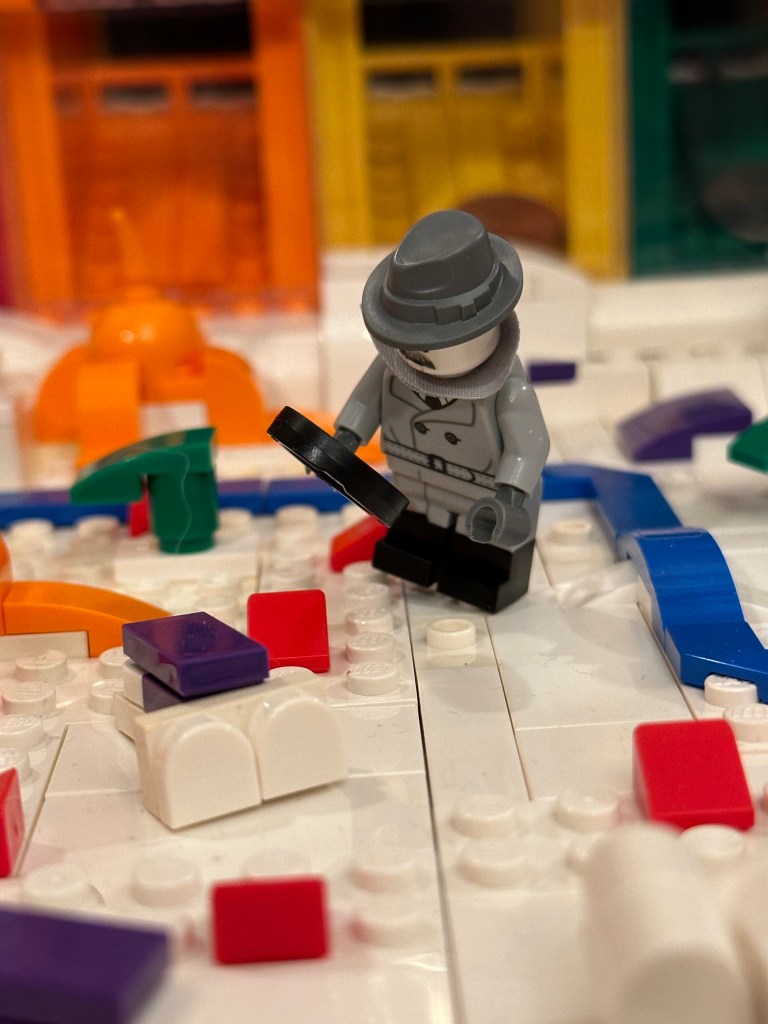
Gold watches from above, attached with transparent pieces for the time being, and the new Noir Detective is on the case, trying to figure out where all this color is coming from. White, meanwhile, the cloud native, is frantically trying to add more clouds to combat the color invasion.
The next step was figuring out how to actually attach the tensegrity cloud at the top. I had to extended it vertically downward so it could attach to something, so it got some round bulk at the bottom. And the cloud it attached to needed a channel for the coin to continue rolling down. Holding the end with my finger, it worked rather well. Just needed to make it a bit more pretty.
At least point, to my future self’s dismay, I was confident I had the tensegrity part down. No matter that I didn’t test the lower cloud balance. If the top one worked so easily, the bottom one should too. Just needed to repeat the same process. What could go wrong?
At this point the build was becoming so large I could no longer build it on my desk. I don’t have a designated Lego building space (not yet, anyway), so I had to move the whole thing to the dining room so I could access it from all sides. I lucked out and found a ton of 2×4 white tiles at the Pick a Brick wall in the Mall of America Lego Store, so I filled out the back of the cloud and added some white to the back of the rainbow. Not enough, but it was progress. I also found there the rest of the transparent windows I was using on the face of the rainbow to keep the coins from falling out.
Now, I had to buy specific parts from Brinklink. As a general rule, I don’t like buying specific parts. I like the challenge of using what’s on hand and being creative. For example, Orange’s pogo stick uses a carrot as the stick. There was probably an easier way by buying the proper orange part. But where’s the fun in that?
That being said, I needed curved pieces on the top, and they needed to be the correct color. I also needed orange and purple bricks. And more Mario clouds. A lot of Mario clouds. So I placed my order and waited.
The next step brought me a lot closer to finishing. White was no longer blowing bubbles, water towers no longer dotted the cloud, and the whole thing looked less rigid and angular. I don’t know about you, but I don’t see many angular clouds.
So what’s the next step? What’s missing? What have I been hinting would be a problem from the very beginning? You got it. Tensegrity.
I wish I had a video to show you how long it took to get that balanced. But at the same time, you don’t want to watch a forty-five minute video of me using kindergarten appropriate profanity. My goal was to have a tensegrity on top of a tensegrity. What this meant was I needed a huge counterweight on the opposite end, which you can clearly see sticks out a ton.
But this also means the who apparatus weighed a ton, so the lowest string needed to be incredibly sturdy. That was tricky. The end result, based on my goal, worked. Was it the prettiest? No. Was it a technical challenge? For sure. But, bonus prizes, the coin drop did work.
If you look closely you’ll see I added chutes to the white backdrop for the coins to roll back and forth in, and the original sort still worked as it did at the beginning of this whole project.
I decided to give the final piece two other versions, given how clunky the top of it looked with the tensegrity and how large I had to make it because of, well, physics. For one, I removed the tensegrity and modified Gold’s cloud, adding it to the top. For the other, I removed Gold entirely, for more of a clean rainbow look. I’ll let you decide which ones you like the most.
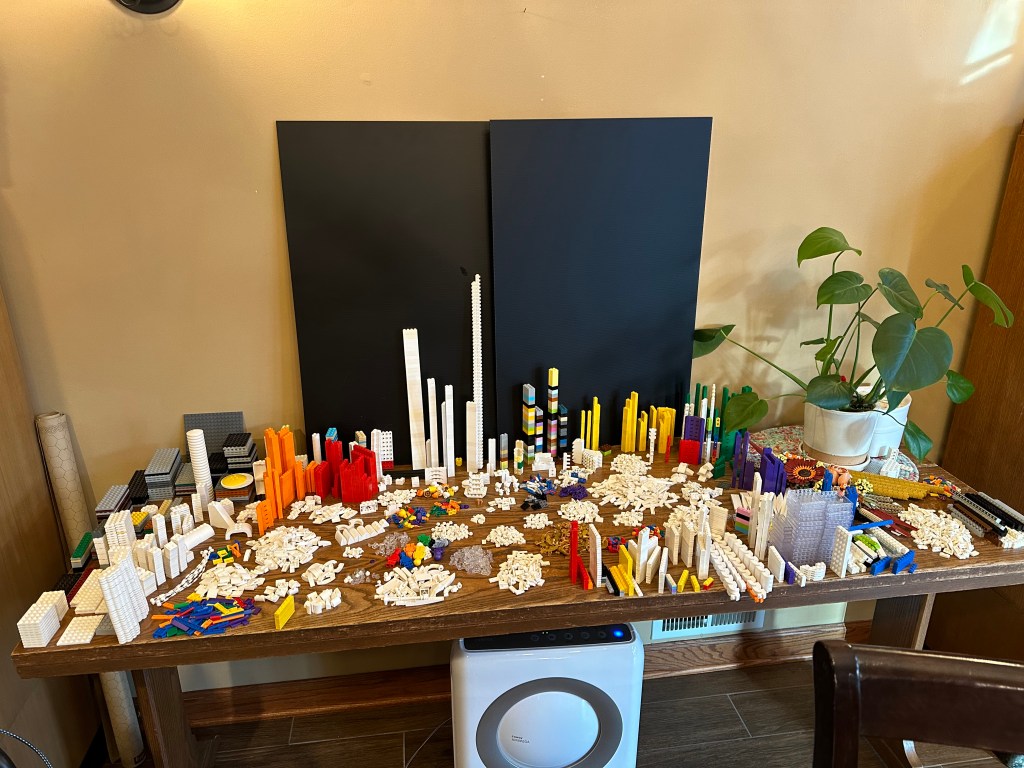
But, the build was done. Number three of five for the Lego Masters application. It was over a month from start to finish, much of the delay resulting from sorting pieces and acquiring pieces. I had so many different bins on hand of differently sorted white pieces. Several times I ran out of 1×2 and 1×4 plates as well as any and all curved white pieces, and I need to thank Roseville’s Bricks and Minifigs store for having a well-stocked bulk bin for me to pull several bags of white pieces from. I was actually there the day after completing this and almost had a PTSD episode looking at that white bin. 🙂
But what do you do when you’re done with a build? Sit there and enjoy your work? Revel in its majesty? What if your kindergartener says he loves the scavenger hunt aspect of the build and wants to tear it apart so he can make his own?
You tear it apart.
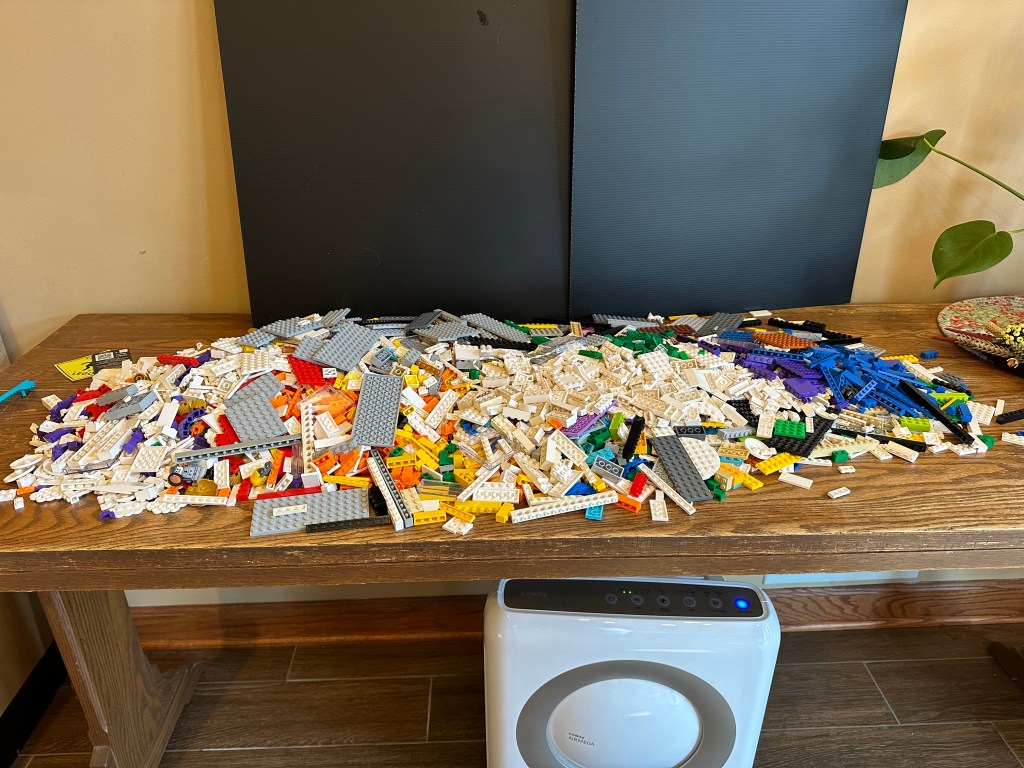
With how hard it is to keep little kids motivated, it’s surprising how focused they get when the activity is destruction. That massive pile is every piece in the build. Remember when I mentioned piece count at the beginning? Have a guess? Before I sorted and counted I said at least 2500. Technically, I wasn’t wrong…
Final piece count: 5328.
And that’s that. Ideation to construction to completion. And then destruction. Now on to the next project, one dedicated to my mom, and likely all moms out there.
Happy Holidays to all! If you don’t celebrate, hopefully you at least get some time off. I’m writing this during my last prep period of the year. I managed to kick out 5000 words the other day so figure I can take the time for another post.
First order of business: upcoming publications. On December 26 a short story of mine will hit the internet on Spillwords.com. I’ll probably do another post then to remind you all. 🙂 It’s a Christmas story about a divorced dad trying to connect with his daughter during their first Christmas with just the two of them. There’s kookiness, drama, heartbreak, and that warmhearted feeling you get this time of year. And bananas. Somehow, there are bananas.
I also just signed up to be on the editorial staff of Water-Stone Review, so I’ll have a healthy bit of reading to do over the next few weeks. I’m expecting a wide gamut of genres and themes, so hopefully it’ll be a fun time.
On a non-writing note, I’ve decided to apply for the next season of LegoMasters. That translates to Fall 2025 because of filming schedules. I need to build five sets of my own design for the application, so I just finished sorting the 90000 Lego pieces I’ve accrued since childhood and am partway into the first build (and already running out of the right color of pieces).
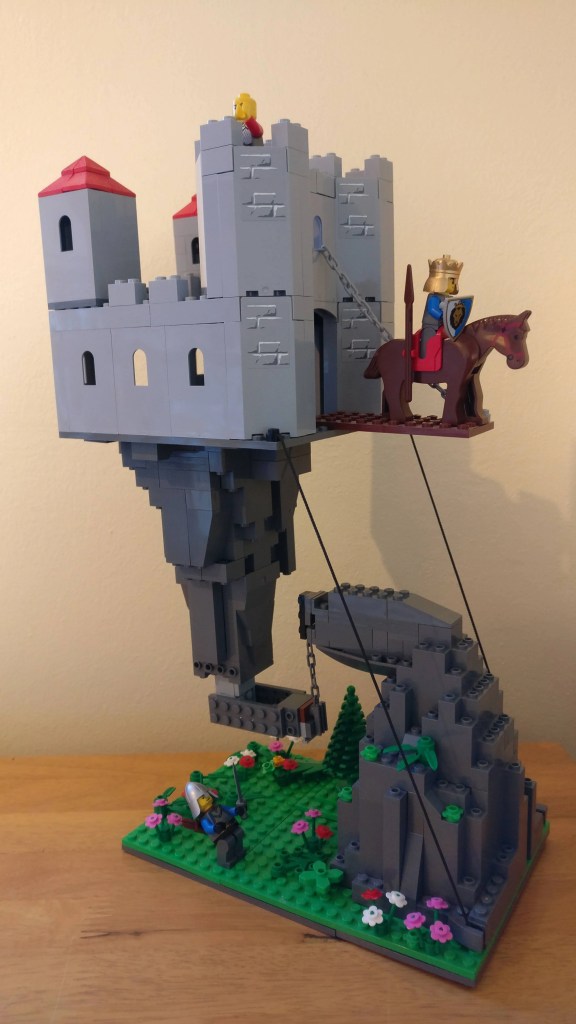
Don’t judge yet! It’s not done! If all goes according to plan it’ll balance perfectly on the beak, like those toys from when we were younger. But instead of being three inches across and made from one piece of plastic, it’ll be over a foot wide and made from hundreds. Given my piece limitation, it might not look the prettiest, but the goal is creating that perfect balance. I can do pretty on a different build.
I have faced some other distractions these last couple of weeks, though I like to think them the good kind of distractions. I had an idea for an educational chemistry game for middle and high school and developed that a bit. I fortunately have subbed a few chem classes during that period and was able to get very positive input from chem teachers, so yay!
I’ve also been thinking a lot about AI’s role in brainstorming and story creation. I obviously don’t want it to generate anything, but I think it could be very useful in organizing thoughts and characters and stories and a whole lot more I won’t delve too far into. Based on what research I’ve done, I don’t think AI is sophisticated enough to do what I want, but in a few years…
I’ll close out with the acknowledgement that I tend to bite off more than I can chew. AWP is coming up in just over a month, and I’m a going to send the first five pages out to agents as part of their Writer to Agent program. But that means I have just over a month to get this story into ship shape. While also building Lego. And working. And designing that game. And prepping for a new baby. And running a D&D campaign.
It’s a good thing I don’t have any hair, else I’d probably be pulling it out.
Merry Christmas, Happy Holidays, and Happy New Year. Enjoy your time with loved ones and remember that diets don’t count on holidays.