Hello everyone and welcome back. A while ago I briefly mentioned a brainstorming strategy I used when coming up with story ideas and promised to go more in depth later on. Well here that is. But that’s not all! I promised one brainstorming method, but today I’ll give you three! (For the record, I hate exclamation marks. I don’t use them lightly. I believe in the current draft of my novel there are exactly two.)
The first one I’ll go over is historically my favorite and one I still use. It requires a copy of the board game Dixit. I will admit I may be spoiled in its creative capacity due to having all the expansions, but when I first used it I only had the base game and that worked just fine.
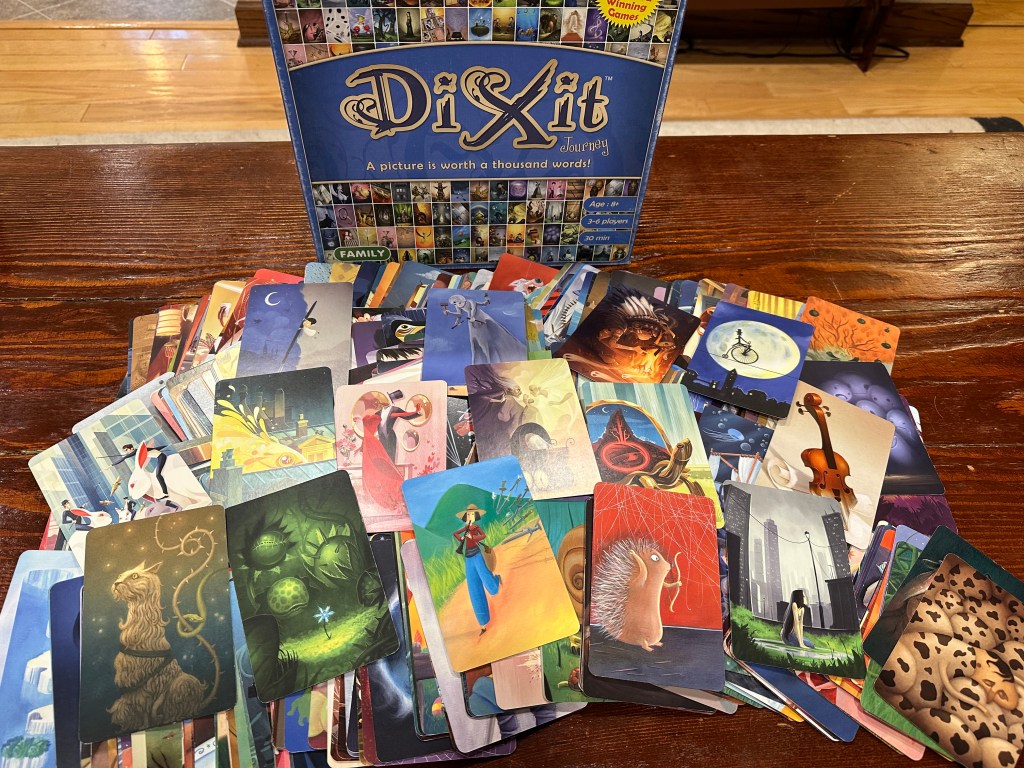
If you don’t know the game, it’s basically Apples to Apples or Cards Against Humanity, except the cards are all illustrations and the age level restrictions are entirely what you make them. We first played with our son with he was three and while his answers were simpler, they worked just fine. But how to brainstorm with them?
I’m going to give two different examples of when I used them and how I approached it. The first example was to create a short story. I didn’t go into knowing the length or the genre, I just wanted to spark something creative in me that was unexpected. So I shuffled up the cards and dealt myself five. I’ve found that dealing more will present too many options and it’ll be hard to focus.
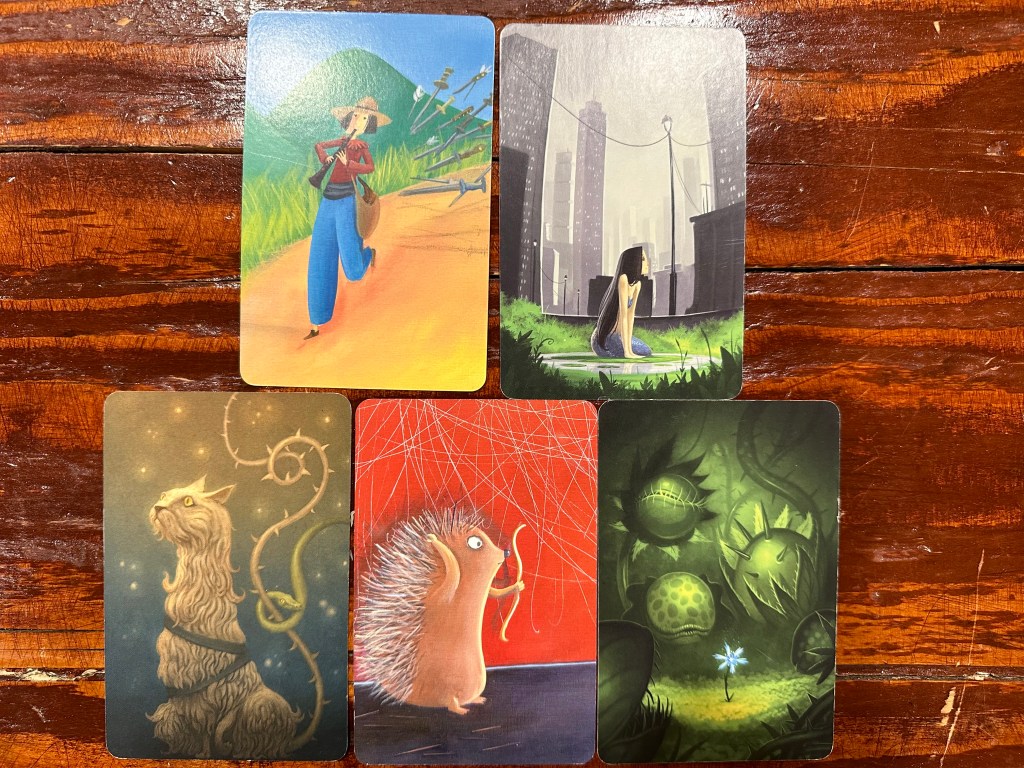
I threw a couple back that were obviously outliers and drew replacements. After a couple rounds of discards I had a set of cards that I knew could work together. As you can see, there are a couple themes that the cards share, with each having their own unique message and imagery.
I’ll use some generalities to explain the story since I don’t want to give it away (it’s currently submitted to a super cool magazine and it’s the piece I used in my MFA application). I knew there was going to be a heavy nature theme, and there would be some form of isolation. From that nature theme, I wanted both plants and animals to feature strongly.
The card that stuck out initially to me as “woah, that could be fun” was the porcupine. The idea of a porcupine shooting its quills as arrows was super fun. But porcupines can’t actually do that. Unless they’re aliens. So science fiction. But if sci-fi, why would they use their quills as opposed to tech? That’s where the card blended with the nature oasis in the city.
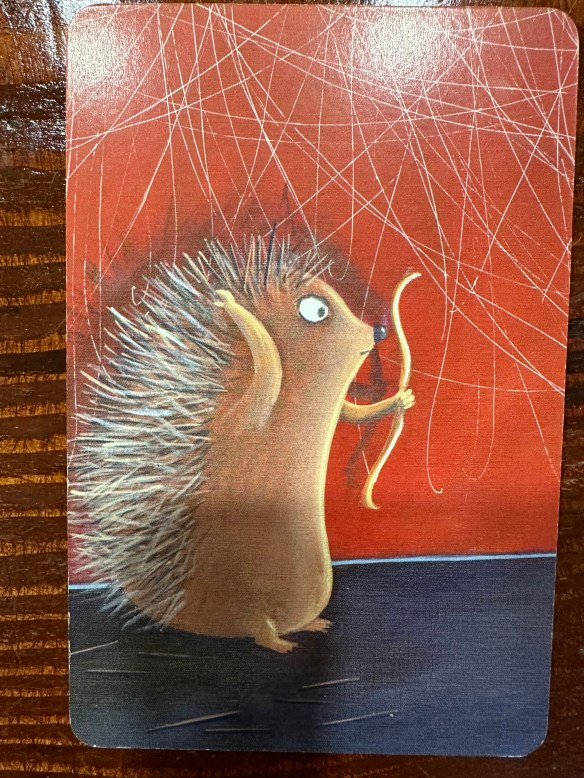
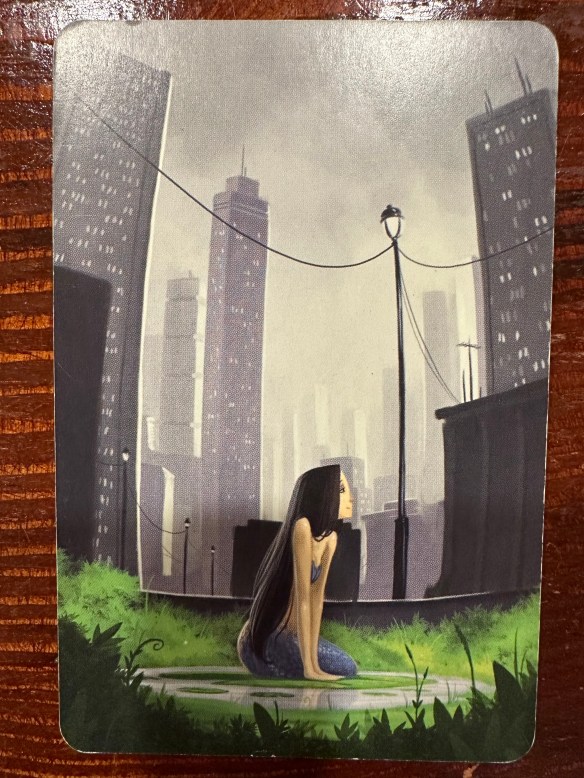
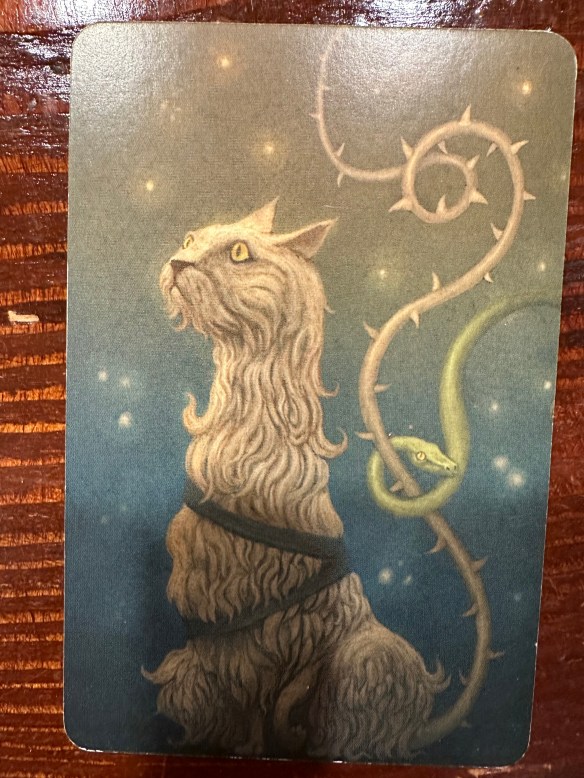
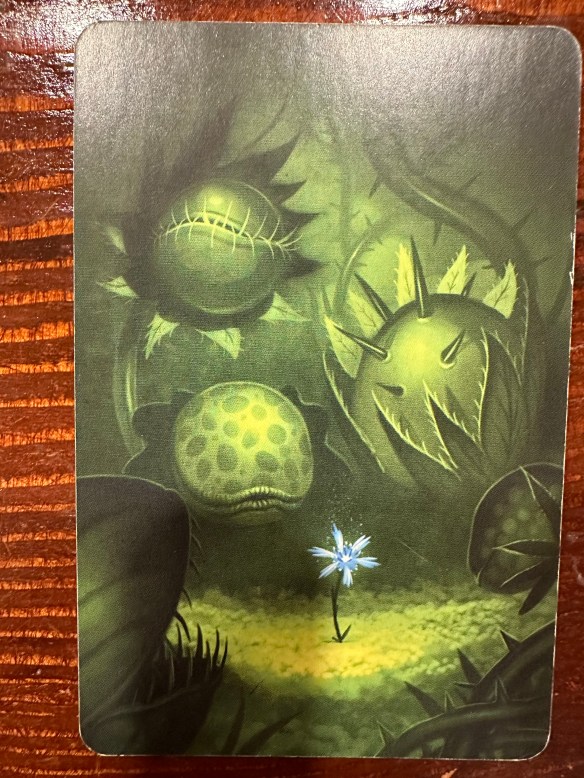

So now I have a setting, a species, and a society. Now I need a story. If the focus of the story is within this unique setting, I needed to lean into that setting, so I combined the scary forest and the lonely barbed tail cat. A scary forest is a good reason to need to shoot quill arrows, and a barbed tail cat makes for a scary denizen. But a nature vs nature story? Where’s the fun in that?
Enter the bad guy. The bad guy doesn’t appear on these cards (neither does the POV protagonist), and I’m not going to give away his role or how that impacts the story, but I will say the last card definitely plays a role in all the other cards.
So with only five cards I was able to create a story I doubt I would have thought up on my own. Once, fingers crossed, it gets accepted by that really cool magazine, I’ll be sure to share so you can get all the details. Now for the next story where I used the cards in a different way.
The prior story I used five cards, and it was for a short story. This next one, I only used one, and it ended up being the driving force in the creation of the novel I’m working on. For this one I was attempting to do the same brainstorming tactic, and there was one card that didn’t fit with the other four. When I went to discard it though I paused, taken in by the image.
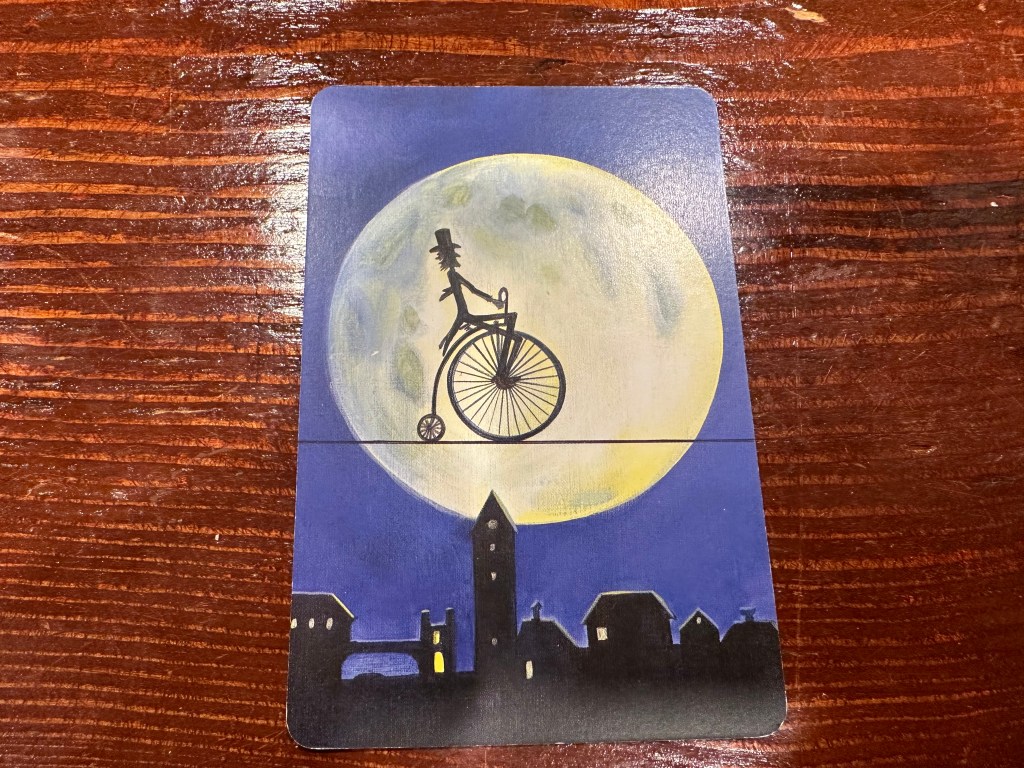
To be fair, being captured by an image can happen anywhere at anytime. But with the Dixit method, you’re intentionally inundating yourself in creative imagery, so in that way you’re increasing the odds. This one card, a man cycling across a wire/string/thingamajig overtop a city made me think, “why”? What year is this city in where the man is riding a penny farthing where there would also be a wire strung up?
At the same time I was also super into Hamilton (and let’s be honest, kind of still am), having listened to it at my brother’s bachelor party (yes, we’re that cool), and the relationship dynamics of Hamilton and Burr as well as Hamilton and the Schuyler sisters were on my mind. I’m going to play this one really close to my chest, but between finding an answer for what the city was and determining characters and motivation I had a full outline drawn up the very next day.
Let’s move away from Dixit now and onto one that I had high hopes for and which is still fun, but not quite as good for story generation, as least not for me anyway. What it is good for is writing warmups. Sometimes it’s hard to find prompts online, especially if you’re in writing groups with varying interests. Enter Story Cubes.
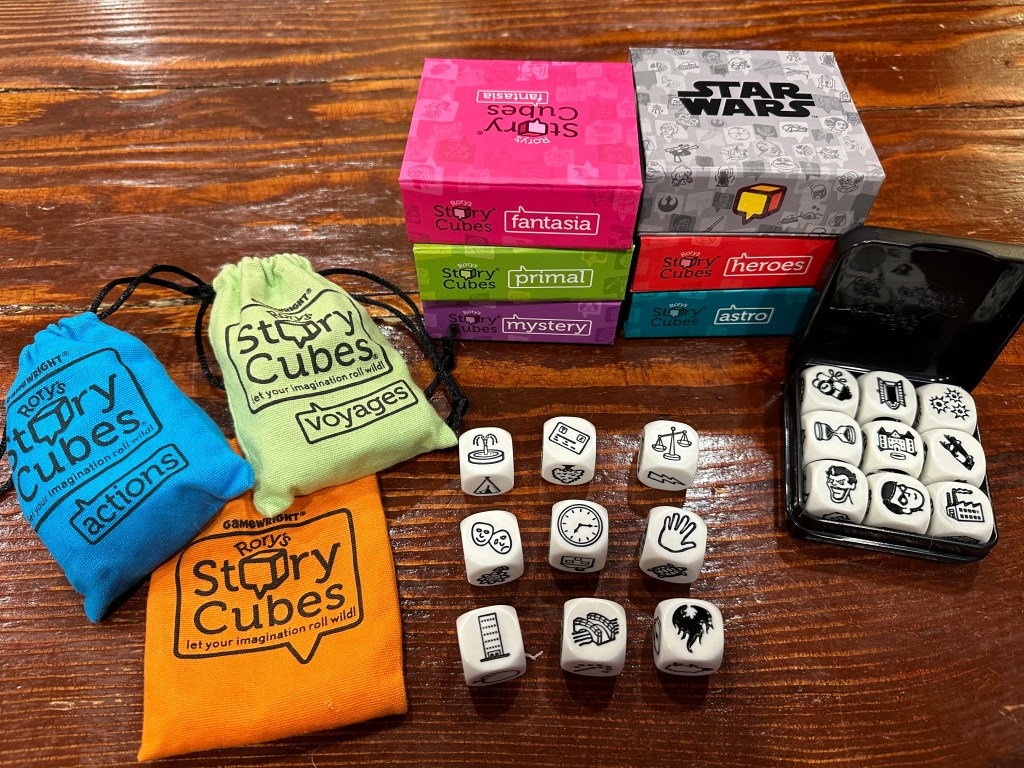
Each Story Cube die has six different images, and each set comes with nine dice. As you can imagine, that leads to a ton of varied combinations of images that can be interpreted many different ways. The result is fun warmups where each person utilizes what sticks out to them the most and you learn different ways to approach similar ideas.

Metaphor Dice are slightly different, and I only just acquired them at AWP this past year. It’s less for creating stories or even prompts, but more to make fun character decisions or observations. It’s especially good at creating unique character background or personality traits. How it works is you roll the dice and follow them red/white/blue. I just now rolled a set and got passion/handed-down/brand new toy. So I’d say “passion is a handed-down brand new toy, that is to say her touch traced the contours of her ex’s chest on his own”. Off the cuff not amazing, but you get the drift.
From here the question, as with the second Dixit example, is “why?” Why does this character feel that way about passion? Is it with a particular partner? Is it because of some past experience? How does this influence their everyday life? I now have a brand new angle to use for my character.
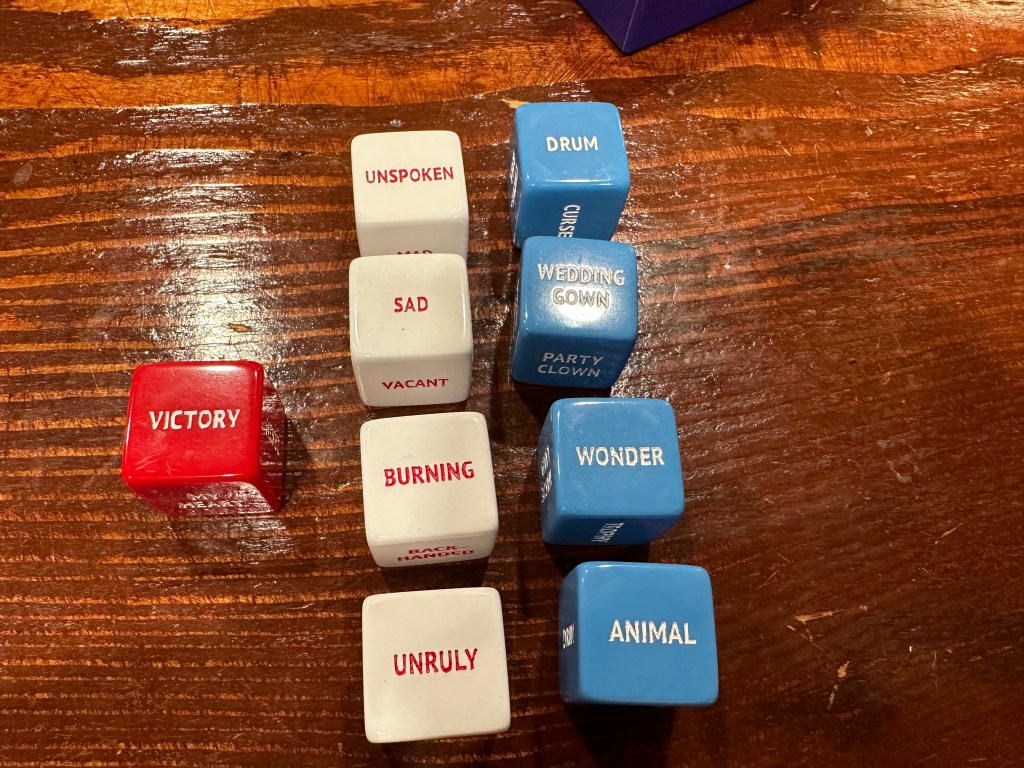
But what if my story doesn’t dictate a romance? What if I know my character is all about, say, honor? Or revenge? Or creativity? If you have a trait you know is essential, but that you’d like to explore, just set that as your red die concept. Roll the others, see what comes out of it. It can turn the superficial character concept in your head into a complex individual with compelling motivations.
The last thing I’ll write about only briefly and will make a post dedicated exclusively for it is ChatBotGPT. I want to go on record and say I DO NOT use AI generated writing, but instead I use it for brainstorming, something it is very good at. I’ve been using it a lot for the last few months, trying it out and seeing what the big fuss was. Sometimes it tries to write for me, but mostly it just answers questions or provides lists. It is not a good writer. But it’s an excellent researcher. But more on that later.
Brainstorming is sometimes a challenging and daunting task, whether it’s new stories or expanding on existing ideas. Hopefully by using some of these tactics you can have an easier and more fun go of it.

 Eric Taveren