Steampunk Research Part 1

Reading research progress: Four books down in just over a week. 

To get ready for my first round of edits on my novel, which I’ve been describing as steampunk adjacent in regards to genre, I felt I should read a bunch of steampunk books both to find pitfalls to avoid as well as potentially gain inspiration for new/revised content. Since my last post just over a week ago I finished The Lost Metal, The Brothers War, The Steampunk Trilogy, and The Aeronaut’s Windlass. The last two are proper steampunk. The first has qualities for sure, and the second was more of a filler book while I waited for the actual ones to arrive from the library. It too though had steampunk facets to it. Now, what was gained from over 1000 pages of genre-focused reading?

Observation 1: Transportation

Most readers know about the stereotypical airship trope in steampunk. Both The Lost Metal and Aeronaut’s Windlass had them, though the importance of each was drastically different. The Steampunk Trilogy had a nuclear powered train (for a page and a half), and even The Brothers War had flying ships of a sort.

Now I know transportation is integral to movement for most characters in most stories, but steampunk really integrates it into the story and the world itself. With such fantastical devices for their era, steampunk’s modes of transportation are a wonder and a backbone of the genre. And the fantastical thing about them? That’s observation 2.

Observation 2: Science! Or, magic. Or something…

I’m only four books in, so we’ll see how long this holds up, but it seems like in steampunk when you want something cool to exist/happen, just make up a reason for its existence. The Brothers War had powerstones and The Aeronaut’s Windlass had crystals. Both provided power and were essentially batteries in a world that didn’t have power otherwise. The Lost Metal, not strictly steampunk, used magic for their airships, and the most ridiculous of all, in the third story in the Steampunk Trilogy, a seeress’ lactation was used to transport a ship to purgatory (it’s a little more complication than that, but still very weird).

Excluding the trilogy, the science/magic/something that powered their technology was also intrinsically entwined in the culture and the world of the story. If a random thing just existed for the sake of coolness, it would seem like a cheat, but for these stories there is a function that not only allows the coolness to exist, but also colors the actions of the characters and the society.

My initial thought when starting my first draft was that I wanted to make everything theoretically possible. That somewhat went out the window in the prologue, but about halfway through I really pivoted from our reality to the reality of the world I was creating. These stories have definitely shown me how much that diversion is useful and needed in the genre.

Observation 3: Weirdness

The winner here for weirdness is The Steampunk Trilogy. When I was first looking up books to read the warning for this one was that it was weird. It is. So very, very weird. But it wasn’t the only one. Lost Metal has shapeshifting immortals. Brothers War has extradimensional techno-demons. Aeronaut’s Windlass has talking cats and hippo-sized spider-things. Weird.

While they were all weird, they were all enjoyable too. It seems that weird is just part of the genre. In my story I don’t have anything like that. At least not yet. Knowing the precedent is there allows for some creative storytelling. Or not. It’s not like these are exact standards to be followed.

Conclusion: 

Of the books, I felt the strongest were The Lost Metal and The Aeronaut’s Windlass. These not only had much better characterizations, but their technologies were integrated into their world in a grander and more seamless way. They presented not only compelling stories, something I believe to be paramount no matter the genre, but a world wholly unique and engaging.

My main takeaways from the readings revolved around technology integration as well as being able to distance myself from the realistic function of that technology. Of course there should still be rules for the technology, but those rules don’t have to obey the same laws of physics that we do. Already I’ve ideas for expanding current concepts as well as a few new ones.

What’s next?

More reading. I just today picked up from the library Infernal Devices, Boneshaker, The Anubis Gates, and The Difference Engine. Until next time, happy reading.

Draft One Complete

So it’s been a while since my last post… I’ve got to try and make this more of a habitual thing. Whenever I forget to do something my wife asks what the point of the fancy Apple Watch on wrist is if I can’t even set reminders. We’ll see how this goes.

But for the exciting news bring me back: I finished the first draft of my novel yesterday. Yes, nine months into it (with breaks for childcare in the summer and from a literally break of my arm) I’ve finished the draft.

Without giving too much away, the genre is something that I’ve never seen done before, nor have people I’ve talked about it with. That being said, my next step is to read a bunch of genre adjacent books before my re-write. Hopefully I’ll see fun strategies as well as things to avoid.

On the list is The Aeronaut’s Windlass, The Steampunk Trilogy, Boneshaker, The Difference Engine, Infernal Devices, Homunculus, and The Anubis Gates. I’ll probably follow that up with Fairy Tale because Stephen King. Coincidentally enough, I’m just finishing with The Lost Metal, which isn’t too far removed from genre as well. Fingers crossed the re-write will go swimmingly.

That’s it for this week’s update (yes, I’m going to try weekly), stay tuned for more.

Fresh Off the Press!

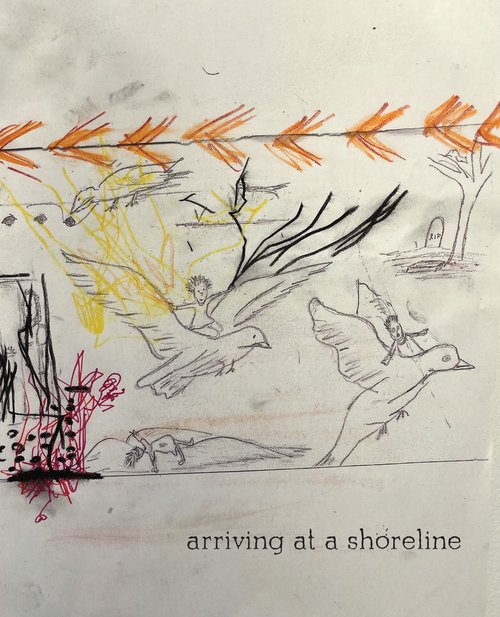
Greetings readers. I’m excited to announce the publication of Arriving at a Shoreline, the new anthology from Great Weather for Media. There are 64 authors featured in the anthology and yours truly is one of them. My short non-fiction piece “reprogramming”, an introspective work about fatherhood and masculinity that plays with form in a unique way to tie in with the content, is one of the 64 pieces featured.

The anthology also contains interviews with National Book Award winner Martin Espada and legendary Bay Area poet Jack Foley.

There will be readings and zoom launch parties over the next couple months, so stay tuned for more info on when I’ll read from “reprogramming”.

Please take a minute to visit the anthology’s site and if you feel so inclined to purchase a copy. As much as I’d love the support, there are 63 other writers you’d be supporting as well.

Writing is hard

As I’ve pursued writing over the years I’ve experienced bouts of inspiration and even more bouts of writer’s block. Figuring out how to get inspired is unique to each person, though I’ll share my tactics for that in a later post. But dealing with writer’s block, that’s a beast all by itself.

When I was younger, whenever I had a lull in writing output it was usually due to video games. I’m a gamer, and between video games and game nights with friends, let’s just say I could have written a metric butt ton more in my 20s. That’s not to say I chose poorly with my time allotment, but as someone now wanting to pursue writing more, I can only imagine what could have been.

The reason I think back to that so much is that as a parent, as someone with a job, writing is hard. Jobs require a set number of hours. Family deserves their time as well. Unfortunately once those obligations are met my energy levels are severely depleted. Some people can work with twenty minutes here or there, but to write effectively I need at least an hour, preferably more.

This became more apparent to me as, for the first time in well over a decade, I’m no longer employed. It was a tough hit to my ego, but it opened up many hours each day to write. And the difference between trying to write with a full time job and trying to write as a full time job is like night and day. My writing output has quintupled at the very least, many days I’ll get even more done. This freedom to devote time to my writing has only proven how much more difficult it is to write while employed.

I recently finished a novel writing course where our weekly writing goal was ten double spaced pages. Ten. That’s about a page and a half a day. It doesn’t seem like a lot, but in a graduate class full of working professionals ten was an overwhelming goal for many. Our professor set that goal with decades of writing experience under her belt. Why only ten pages? Writing is hard.

This past spring I had a conversation with an alumni from my masters program, Mindy Mejia. She just put out her fourth book and she spoke on the time it takes to write. Her first book she wrote during her masters program. Her second book she wrote during work lunch breaks. Four years of lunch breaks. This is a published and well received author, and it took four years to write a book, as she was juggling kids and work at the same time.

Writing is hard.

I don’t have a solution to this. I can’t change reality. What I can say to writers out there who are struggling to put pen to paper, to fill up that Word doc, is you’re not alone. Unless your name is Stephen King or J.K. Rowling or Brandon Sanderson you’ve probably got a day job. Pair that with a family and a social life that are all meaningful and important, squeezing that novel or short story into your day is a tall order. But you can do it. You’ve got something to say, and there are people who want to hear it. It’s going to be tough, but you can do it. Write during your lunches, schedule a few hours of uninterrupted time, let your superego reign and convince your id that Great British Baking Show can wait until the end of your chapter. Writing is hard, but you can do it.

Welcome to my new blog

Hello readers and welcome to the inaugural post of my fledgling blog. The first thing I’d like to do is something a writer must always keep in mind, regardless of content: set expectations. In an epic fantasy that might be pairing the protagonist’s backstory with a complimentary quest, in a mystery it could be laying out a killer’s pattern that the detective should know how to follow. In romance… we all know the expectation there.

As an author with only a few published pieces under my belt I’m not in a position to give expert writing advice, though being more than halfway through my MFA I could probably give some valid pointers. The purpose of this blog will instead be to highlight what I’m currently working on, promote what’s coming out, and to talk about books.

I’m going to go out on a limb and say that if you’re reading this, odds are you like to read. So do I. So do a great many people in this crazy world we live in. So let’s talk about it. Between writing, class, and family, my time is limited, but I’ll try and put out weekly posts, alternating in some capacity between talking about my writing and talking about others’.

Thank you for finding your way to this tiny corner of the internet and I hope you enjoy yourself.