The End is in Sight…. Farewell Hamline

This is it. One more day and I’ll have my MFA in hand and a noticeable amount of time now available to write things of my choosing. I don’t want that to sound like I’m complaining about the work I did in the MFA—many of my published short pieces came directly from assignments. But I do have drafts of four different novels that I haven’t had time to go back to, so this summer will include a fair amount of editing and revising.

But I’m just about done. Tonight I’ll read a portion of my thesis to what’ll probably be a medium-sized group of people, and then commencement is tomorrow. I even get one of those fancy hoods. Ooooh. 🙂

It’s crazy to think about what’s happened since I enrolled in the program. The plan was always to do one class a semester, but then covid hit and lockdown plus a two-year-old makes all plans go out the window. When I started, my son was one. He turned seven last month. When I started, I was working at a finance job I’d been at for over a decade. Now, three jobs later, I’m interviewing for teaching positions. When I started, Trump was president. Now… oh. Shit.

My first published piece resulted from one of my classes making me write creative non-fiction. Several fiction publications followed, and just a few days ago I heard that a poem—yes, a poem—of mine was accepted into a magazine. I didn’t write it as part of MFA coursework, but I did so while surrounded by MFA people.

I doubt I’ll divorce myself entirely from the program. Reading for Water-Stone will hopefully be a thing this winter, and the MFAC (children’s lit MFA) program has lecture passes that I’ve already made use of. Not to mention the people.

There aren’t many places where you can find people who can give good, quality feedback on your writing. I was lucky enough to find some in my wife and best friend, but they are just two people, and, as I learned after writing a horror story, they can’t be good readers for everything. But when you leave with your MFA, you also leave with a community.

I’m hoping life both will and won’t change. I hope it will so I can get those books finished. 🙂 I hope it won’t in that I might stop by Hamline’s Creative Writing house and chat with Meghan or I could attend events at which alums and students are reading. However it works out, the MFA was a wonderful experience and has transformed me from a person who sometimes writes into a writer.

Accidental Inspiration

Hey all. This’ll be a quick one. While at AWP I was talking with a horror writer and we were sharing setting ideas. We both have personal history in rural settings, and after I described my setting and a general idea to go with it, he full body shivered and told me to write the story. ASAP.

Now that thesis is in, I think that’ll be a good mental reset before I finish drafting the novel. I’d been thinking about the theme of it, and the tone, and my mind went back to a Stephen King story I’d read ages ago, The Girl who Loved Tom Gordon. In my mind it was a short story, probably because I’d read the pop-up book version. Lo and behold, the actual book was on my bookshelf. Points for being a book collector.

So I grab the book, stick it in my bag for the hotel (my wife has a work event in Kentucky and I’m on baby duty), with the expectation to carve out some time to work on it. Then I see this in the hotel:

It’s not exactly the Overlook Hotel, but the vibes are definitely there. Here I am, planning to read Stephen King, and I walk into this hotel. To top it off, I go into the bathroom, and the shower looks a lot like the one Rosamund Pike uses in Gone Girl to wash off all the blood.

I wanted to write a horror story. Looks like I’ve got plenty of inspiration to work with. Maybe instead of sitting in the lobby downstairs or at the desk in the room, I’ll just camp out in the hallway, cross-legged, and let the periphery mess with my head as my fingers work.

Until next time.

Also, what’s with these libraries in Kentucky?! I feel like they’re doing them very right, or very wrong.

On the Streets in Santa Monica, and Thesis too.

Two weeks ago I flew to LA to attend this year’s AWP Conference and Bookfair. AWP itself was about the same as usual: some good panels (yay Juan Carlos Reyes), some not-so-good panels (I’m too nice to name names), and too many books finding their way into my backpack (who’s excited for Gods?!).

A few AWP firsts:

  • Someone asked if I’d be interested is doing a reading next year 🙂
  • One of the people I split a hotel with head-butt me in their sleep 😦
  • I wrote and submitted a piece while at the conference 🙂
  • I took an extra day strictly for research 🙂

I mentioned in an earlier post that I had a conundrum with my current project. It takes place in LA and I started writing the pieces before last year’s fires. I had no idea how I should address them in-story. So I took the opportunity to talk with locals and get see what the fire was like for them, how it affected the areas I was writing about, and from there I had to make my decision.

One thing that worked in my favor, specifically regarding the ability to talk to people uninterrupted, was that it was overcast and a little drizzly in the morning. That meant I only had to try a little to not bump into people as I walked on the Santa Monica pier. I talked with one of the employees there, because the tourists outnumber locals 99 to 1, and he said on nice day everyone on the boardwalk is shoulder to shoulder the whole way through.

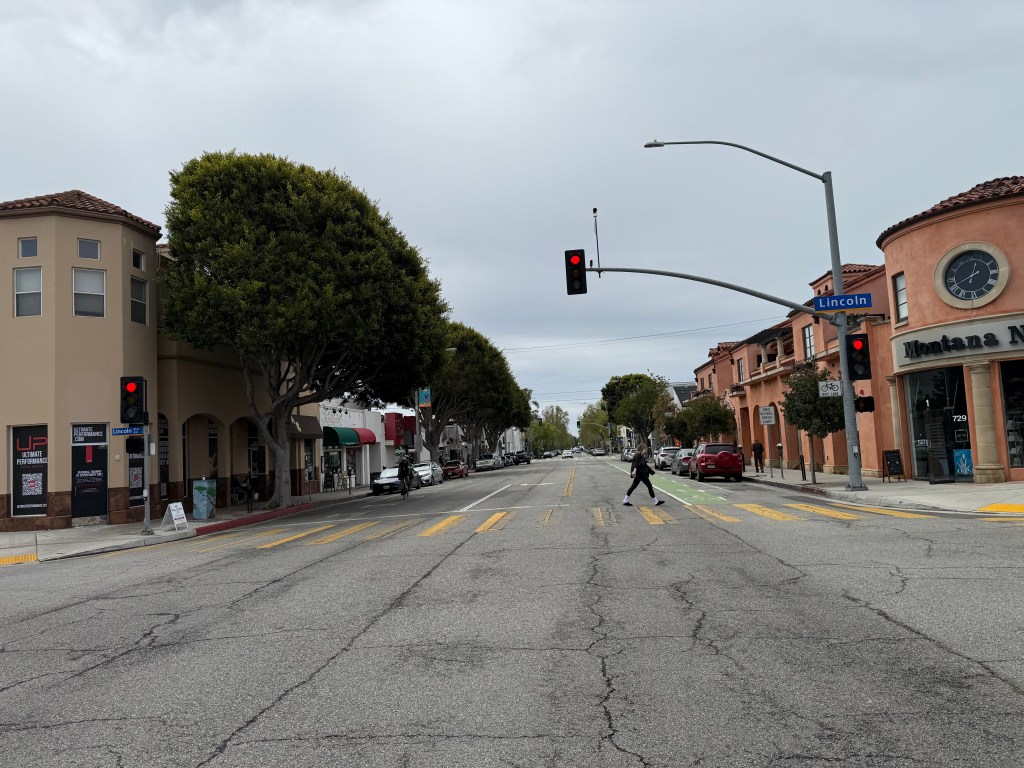
From the pier I needed to head to Montana Avenue, which wasn’t too far away. This was, of course, after walking a fair amount to find the bus to Santa Monica and walking along and around the pier. I’d read up on the area online, but seeing it in person was incredibly beneficial. One, I didn’t realize how much foot traffic there’d be. I’m used to Grand Ave in St. Paul, where parking is a nightmare because nearly everyone drives there and so much of the walking is to and from vehicles. Not the case on Montana Ave.

As with the pier, nearly everyone was a tourist. The only locals I found were employees of the stores, old people sitting outside of coffee shops, and shoppers at Whole Foods. I made the rounds, stopping at a few specific locations that I plan on incorporating into the story, and got a much better idea of the pulse of those dozen or so blocks.

The most interesting thing I found wasn’t something described online at all. Approaching from the west, the shops spring up almost out of nowhere and look new and fancy. Approaching from the east is the same experience. But there’s a little section in a middle, only a few blocks long, where the buildings, though still nice, have a distinct ma and pa shop feel to them. I didn’t feel like they were tailored to the trendy elite of the area.

My exploration kept me going for a while. A long, long while. At one point I checked my steps and swore out loud when I saw it read 20000 steps. By the end of the day, I’d walked nearly fourteen miles.

Those who personally know me know I’m not in bad shape. But they also know I’m not in walk fourteen miles in one day out of nowhere shape. Oh man did I hurt afterward. But it was worth it. I got home, used my research to update my thesis, and dropped off the printed copies this past Monday. I may have killed a tree in the process of printing them, but it’s for a good cause.

Now I wait a month until my thesis defense. I’m not worried, but waiting that long for anything can be a bit much. So maybe I’ll take a mental break and write a short story. Horror sounds good…

Until next time.

Hamline MFA Under Attack

Twenty-two years ago I moved from Washington State to St. Paul, Minnesota, starting my adult life at the small liberal arts school, Hamline University. My expectation was that I would obtain an academic education (at the time I thought I was going to be a journalist) and that Hamline was the next step in my journey.

While I did get that academic education, Hamline also provided me with community. The culture was welcoming to all and the faculty and students were phenomenal, especially putting up with my ignorant, youthful bullshit. After graduation I lived with classmates, attended their weddings and baby showers, and they attended mine. I stayed in Minnesota because of that community.

Imagine my heartbreak when I heard that that very community was under attack. Hamline’s Creative Writing MFA program, the oldest and largest in the state, as well as its literary Journal Water-Stone Review, have been told by administration they will be sunset, and that no new students will be admitted. Given the age of the program and its integration in the literary community, both in Minnesota and beyond, this abrupt decision seems unfathomable.

If you’re unfamiliar with what sunsetting a program looks like, it means that all enrolled students will finish their degree, but as more and more graduate, the variety of course offerings will diminish as will their community of colleagues, with no new students joining the ranks to collaborate and learn with each other.

Water-Stone Review won’t even have the luxury of a slow death spiral. Its budget has been cut, and unless something changes, will become the next literary magazine to die. As one of the oldest print magazines still in production, Water-Stone Review is a very well recognized and respected magazine in the literary community, receiving Pushcart Special Mentions, and appearing in Best American Essays, Best American Short Stories, Best American Poetry, and Best Nonrequired Reading. There are even undergrads who come to Hamline because of Water-Stone and the promise of being a part of its production.

I understand that literary magazines and academics programs do fail from time to time. If this was a normal situation treated fairly and transparently, then there wouldn’t be an issue here beyond dismay. But there are some serious underhanded shenanigans going on by the interim administration, who for some reason seem to have it out for the program.

The normal process for sunsetting a program is to have the faculty vote on it, and then if that’s approved, it’ll go to the board for a final decision. Instead, the administration put out an announcement saying the sunsetting was going to the board, before the faculty voted. This obviously can’t happen, but what it does is sends a message to the faculty that it’s a done deal. Those who didn’t have an opinion on the matter might be swayed by this.

Do I think the MFA will go away? Probably not. The faculty seem to be supportive of the program and will hopefully not vote for its sunset. Water-Stone Review is another matter. The literary magazine has existed on its budget, a mere $26,000 when compared with Hamline’s profit of over seven million a few years ago (I don’t have access to the most recent tax returns) and that it pays its interim president over half a million. Obviously a very fiscally focused decision.

What’s particularly galling is that this underhanded effort to destroy the program and magazine is being spearheaded by interim administrators. Interim President Kathleen Murray and Interim Provost Andy Rundquist are both on their way out, permanent positions having been hired and starting in the fall. Yet these two have taken it upon themselves to target the program before they leave.

One of my classmates actually reached out to Interim Provost Rundquist to try and get clarification and understand his position. He was dismissive and unprofessional, and when she, a grant writer, offered to get funding to save the lit mag, he wouldn’t even acknowledge the idea. Like, refused to respond and address her.

So what is the MFA program doing about this? Obviously they’re fighting it with everything they have. I’ve read some communications that aren’t open to the public, and they’re giving it their all. The only problem is there’s only so much they can do. Will they save the program? Probably. It’s within their power to appeal to faculty for that vote. What is not within their power is budget decisions. The cutting funding for Water-Stone can happen regardless of the vote.

And it’s not like the MFA is asking for a lot. They’re not demanding a larger budget (which has been drastically cut since the interims have taken charge) or for any handouts. All they want is a delay in the decision. With permanent administrators starting in the fall, it is only right that they, administrators invested in Hamline’s future and not already walking out the door, weigh in on what happens to the program. If the new administration agrees it should be sunset despite increasing enrollment, and follows the proper steps with which to recommend and enact a sunset, then the MFA faculty will work with that. They only want a fair shake.

A third thing, which may not seem as important to someone invested in the arts but not specifically to Hamline’s program, is the termination of Meghan Maloney-Vinz. She is Hamline’s Creative Writing Programs Coordinator, meaning the MFA, BFA, and MFA in Children’s Literature, the latter two not currently at risk of sunsetting. She is also the Executive Editor of Water-Stone Review. She’s a graduate of the MFA program and has been with Hamline for years. Her institutional knowledge helps maintain the three programs, and her loss would hobble the MFA as it tries to prove its efficacy and worth to the new administration. And, knowing and working with her for the past six years, she’s a wonderful person.

Hopefully, even with this brief overview, you’re somewhere between annoyed and appalled at the actions of the interim administration. You may not have the same investment as I do, may not have your heart sink as you see someone trying to rip this community apart, but that doesn’t mean there’s nothing you can do.

Sign this petition at Chage.org to show your support. If you have a personal connection, share that. The decisions haven’t been finalized yet. The board hasn’t met. If they see the community rallying around the program, they might choose to ignore the interim administration’s recommendation. And they might instruct the administration to leave Water-Stone and Meghan alone. But only if they know how important they all are. And they are important.

If you want to know more, here are some articles and a news report about what’s going on. And if you want to talk about or share a story here, by all means do so. I’ll be in LA in two weeks at AWP talking with many others in the professional writing and educational community, and hearing your and their stories will only help the MFA’s cause.

Interim-Administrators plan to sunset the Creative Writing Master’s program – Oracle

Administration makes detrimental change – Oracle

We Need Artists & Authors – Oracle

Hamline University could cut creative writing MFA – Local News

Los Angeles: A Setting Conundrum

Last spring I decided to have a portion of my novel take place in Los Angeles. One chapter would be closer to downtown, and two chapters would be in Santa Monica. I’ve never been to LA, so I did a bunch of research, found some locations that worked well for theme and ambiance, and went to town.

Then I found out AWP would be in LA this year. Perfect! I’d extend my trip a day, and see my locations in person. I could talk to people, get a feel for the community and the culture and really lend some authenticity to these chapters. Then the fires happened.

I don’t feel I need to go into detail as to how the fires have impacted the LA area, and how terrible the situation is. Everyone sees the news and social media posts. It’s bad, I acknowledge that, and I know the problem I’m about to pose is nothing compared to what they’re dealing with in LA.

What I’m struggling with is how this will impact my story.

The way I look at it, and this can apply to any setting where a significant event has occurred, is I have three options on how to proceed. The first is the easiest: pretend it never/hasn’t happened. I write fiction, so I can take liberties with the when of a story, or even the very world. I could set this pre-fires, create an LA that until very recently is the LA that most people know. All that would take is incorporating my trip research as I’d already planned, and either defining a year of the story (summer 2024 and earlier), or just pretend my areas were never impacted by the fires.

Option two is probably the hardest: incorporate the fire, including community impact. Given my knowledge of LA is based solely on media and research, this is the most daunting. When I go there in March, I’ll see firsthand the impact of the fires in the communities, especially the locations I’ve chosen to be in my story. By talking to people, I’ll hopefully hear what Santa Monica used to be like, the struggles they’re facing as they rebuild, and how they (individually and collectively) are moving on. My character’s family has a business on Montana Ave, so this could present a good opportunity to show community involvement, as well as allow for any creative liberties with building size and placement.

As daunting as effectively portraying that community will be, another concern I have is that it might look like I’m exploiting the community for my narrative. A terrible thing has happened, why not shove it into a story for emotional appeal? Right. Obviously that’s not the goal, as I’d already decided to use Santa Monica well before the fires. But I can’t deny that including the fire aftermath would inherently create an emotional hook for some readers. As writers, creating emotional connections with readers is the goal, the concern is that it might look like I’m taking advantage of a bad situation.

The third option is to have it take place elsewhere. I’d chosen LA because I needed a large city that wasn’t New York (where a healthy chunk of the book takes place), and I was looking for a certain vibe of wealth (Ch. 1) and then a nearby trendy shopping area with a more laid back feel (Ch. 2-3). I’m sure that combination exists elsewhere, but picking somewhere else would be learning a new location, researching it, adapting the narrative to account for it, etc. Definitely more work than option one, probably less work than option two.

So that’s the conundrum. How do I deal with a real natural disaster in my writing? Do I take the easy way and ignore it? Do I remove my story from the location entirely so the disaster has no bearing whatsoever? Or do I try and incorporate it, risk sounding exploitative and try to put some real truth into a piece of fiction?

AWP is at the end of March, so I still have some time to decide, but I need a completed draft by late April. Whatever decision I make, I’ll have only a few weeks to incorporate it. Maybe talking with locals will help make that decision for me. Maybe talking with other writers can give me some insight. Right now, I’m leaning toward including the fires, to have a very real way to tie my character into the community, but we’ll see.