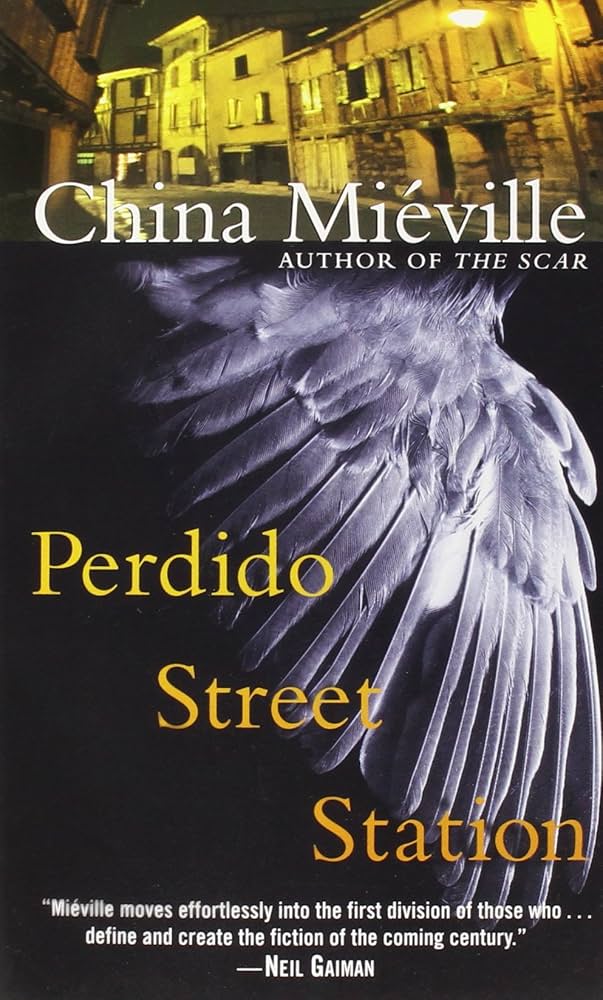
Welcome back for another book review. I want to start this one off with a bit of context, because unlike some of my other reads, I didn’t come into Perdido Street Station with any prior attachment. No familiarity with China Miéville, no knowledge of Bas-Lag, not even a vague sense of what I was getting into.
This was a recommendation—specifically because of a novel I’ve been working on that deals with dreams and planes of existence. Apparently, this was in my wheelhouse.
Based on the cover and title alone, I assumed something grounded. Maybe real-world adjacent. A touch of magical realism, perhaps.
Nope.
Not even close.
What even
is
this book?
I’m still not entirely sure I can answer that cleanly.
The best way I’ve been able to describe it is this: if a metropolis is a melting pot of people and cultures, then Perdido Street Station is a melting pot of genres. It pulls from everywhere—fantasy, sci-fi, horror, weird fiction—and just… lets them all exist together.
You’ve got:
- AI
- demons
- bio-modification
- hybrid species
- political intrigue
- and things I still don’t quite have names for
And none of it feels like it’s trying to justify itself. It’s just there. Part of the fabric.
One of the biggest differences between this and most fantasy I’ve read is that there’s no softening of the edges. Fantasy often leans into escapism. This book does not. The darker aspects of city life—sex work, violence, exploitation, harm—aren’t implied or backgrounded. They’re present. Casual, even.
There is no escapism here.
New Crobuzon as a living place
What stuck with me most about New Crobuzon wasn’t just how strange it was—but how logical it felt.
The city has a distinct regionality to it. Different areas shaped not just by economy, but by religion, ambition, history, reclamation—layers of cause and effect that mirror real-world cities like New York or LA. It feels built over time, not designed all at once.
There are moments where Miéville introduces entire chunks of history or concepts—a war, a forbidden chemical, some piece of infrastructure—and then just… moves on.
No payoff. No return.
And weirdly, that works.
Because that’s how real cities function. There are things baked into the bones of a place that you don’t fully understand, but they still shape everything around them.
That said, part of me did want some of those elements to loop back around, even in small ways. Not everything needs to matter to the plot—but I wouldn’t have minded seeing more of those threads resurface.
Characters (and a few frustrations)
I resonated most with Isaac. He’s an ideas guy. Knows a bit about everything, constantly chasing concepts, theories, possibilities. That clicked for me immediately.
Lin was interesting—until she wasn’t. Early on, she feels like her own person, fully realized and independent. But once things start going sideways, it felt like her role shifted in a way I wasn’t expecting. Not quite a full “fridging,” but adjacent enough that it stood out.
Yagharek is… complicated. For most of the book, he’s an enigma with clear goals and a withheld truth. And then the last portion of the book reframes him entirely. I wasn’t expecting that resolution, and I’m still not entirely sure how I feel about it—which might be the point.
The only character moments that really didn’t land for me were with the mayor and the crime lord. Both make snap decisions and then stubbornly refuse to engage with any logic that contradicts them. I understand emotional decision-making, but given their positions, it felt off. Like they should be more calculated than that.
Prose: adjustment required
Miéville’s prose and I did not get along at first.
I tend to prefer accessible writing, and the opening descriptions had me worried I was in for a long, dense slog. But once the perspective shifted to Isaac and the world started populating with its… inhabitants, my reaction changed.
Not necessarily to comfort, but to acceptance.
At a certain point, I just rolled with it.
There are stretches—particularly in broad environmental descriptions—where the prose gets dense. Not unreadable, but heavy. For me, with aphantasia, those sections didn’t always land as intended. I could appreciate the craftsmanship, but the imagery didn’t fully translate.
Where the writing did hit was in the more grounded, horrific details.
The parts that stick
The remade.
That’s what stuck.
The idea of punishment through forced bodily modification—people reshaped into tools, into warnings, into something less than human. And not just the concept, but the examples. The woman whose baby died. The people turned into objects for others’ use.
It’s messed up.
Deeply.
And those moments linger.
There are very few books where I actively think, “Yeah, this is not for everyone,” and mean it as strongly as I do here. I told my wife outright—this is a hard no for her. Harm to children, to vulnerable people, to animals—if that’s a line for you, this book crosses it. Repeatedly.
Craft talk: Worldbuilding as excess (and intent)
I wasn’t planning on diving into craft here, but it’s hard not to with this book.
So let’s talk about worldbuilding density.
A lot of advice around worldbuilding focuses on restraint:
- don’t over-explain
- don’t info-dump
- only include what serves the story
Perdido Street Station does not care about that advice.
It builds outward instead of inward. It layers idea on top of idea—some relevant, some not, some that feel like they should matter but don’t. And instead of tightening the narrative, it expands the world.
Normally, that would be a problem.
Here, it feels intentional.
Because the goal isn’t just to tell a story—it’s to make New Crobuzon feel like it exists beyond the page. A place too big, too complex, too messy to ever be fully understood.
Did I want more payoff from some of those elements? Yes.
Did the lack of payoff contribute to the sense that this world doesn’t revolve around the protagonist?
Also yes.
And that’s a trade-off I can respect.
Final thoughts
Perdido Street Station is not an easy read. It’s dense at times, unsettling often, and uninterested in making you comfortable.
But it is fascinating.
If you love deep, layered worldbuilding—if you like your fantasy weird, expansive, and unafraid to get ugly—this is absolutely worth your time.
If you’re looking for escapism, or if graphic depictions of harm are a dealbreaker, this is one to skip.
As for me, I’m still not entirely sure how to categorize it.
But I’m very glad I read it.

