Just a quick post here: If anyone lives in or around the Twin Cities, VERS/ATILE is hosting a reading this Sunday at 6pm. There are featured readers, followed by open mic. I’m one of the featured readers and I’ll be reading a couple of published shorts as well as one scheduled for publication this fall. Sort of a sneak peak.
If you’re interested in attending, the reading will be at Gingko Coffeehouse on Snelling in St. Paul.
I should note that if my wife ends up having our baby on Sunday, I’ll probably not be there, but I’ll update this if that’s the case.
I’ve posted before about my love of Lego, and how I’ve decided this year to apply for Lego Masters once the applications open up. One of the application requirements is to give five examples of MOCs (My Own Creations) that you’re especially proud of. I never was in the habit of taking pics of what I built—I mainly played for fun—so that meant I needed to build five new creations, and I thought it’d be fun to share the design and build process of one of them here.
Also, for those who want a challenge, as you follow the steps, see if you can come up with a piece count guess. I’ll post it at the end.
The very first step in the design process is to figure out the general idea and story. Similar to when writing a book, no? 🙂
This one came from my kid. Most kids have a singular favorite color, especially when they’re younger. Westley’s favorite colors for years now have been pink, golden, silver, and rainbow. He’s also super into math and we’d been working with counting currency. So I decided to make a piggy bank that was also a rainbow.
Now, where do we see rainbows? Up in the sky, with the clouds. So bank, rainbow, clouds. I have a setting, and I have functionality and play (something I prioritize in my Lego builds). I see tons of amazing Lego builds which are super pretty and complex and crazy cool, but they are not meant to be touched. There’s definitely a place for that. I prefer through builds that are meant to be handled and interacted with. You play with Lego, right?
But now I needed to add a story. A rainbow on a cloud presents a nice visual, but why is it there? Because someone wants to turn the white cloud into rainbow colors, of course. Cause chaos! Be crazy! Just be careful you don’t step on that dropped piece while bare footed.
The final aspect, one I knew I wanted to try at some point across these builds, was a tensegrity element. For those unfamiliar with the terms (I was until recently), a tensegrity build uses tension to give the appearance of floating. As gravity pulls down, the tension of the strings resist and hold the object in place, pulling from different directions.
There’s a science to this, what with center of gravity, balance, equilibrium, and—spoilers—I probably should have thought hard about that early on.
Looking through my photos, I probably should have taking more pics throughout the process, but I’ll explain as best I can in chronological order. First up: the coin sorter and how to make a large, curved rainbow.
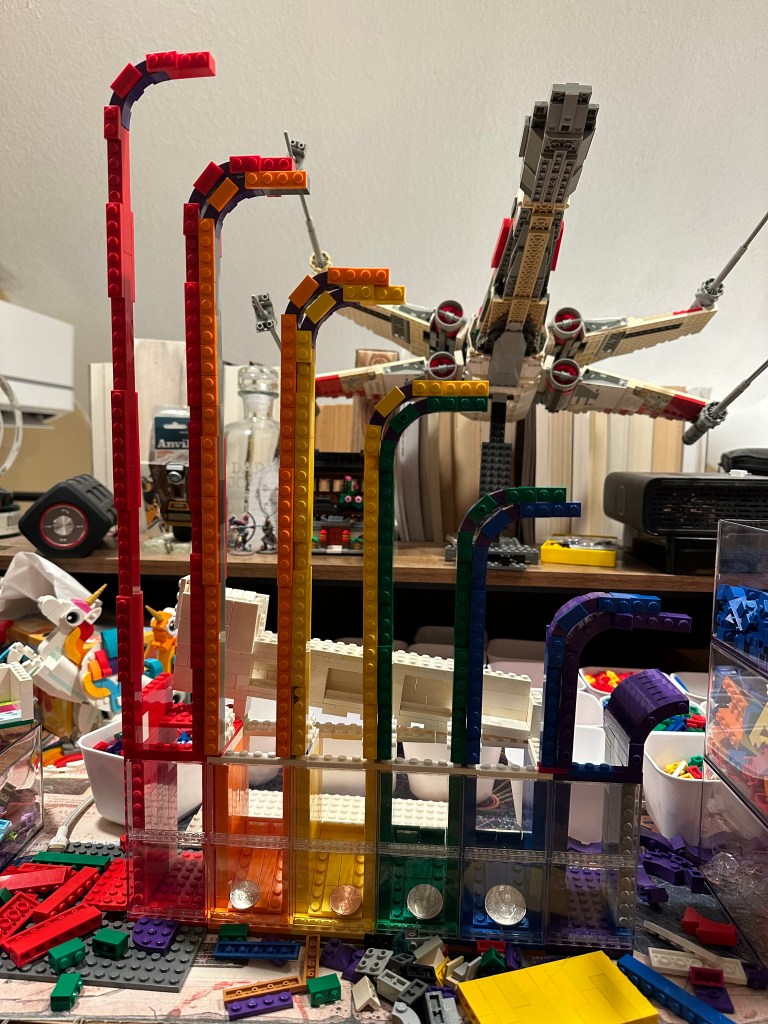
I didn’t take a picture of the whole coin sorter, but you can seen the end of it on the left. The white enclosure sits at an angle, creating a gentle slope, enough that the coins will roll but not so much that they’ll shoot past their respective exits. 1×2 wedges run from the beginning to the last section, tilting the coins so they lean toward the hole. This serves two functions: to aim the coin toward its hole (insert Happy Gilmore reference), and to create the proper elevation shift so the penny and nickel don’t fall out at the same spot.
To control where the coins fall out, I simply added a plate across the top of the hole, making the hole smaller and smaller as we went from nickel to penny to dime. And that’s all it took. And with four coins and six rainbow colors, it was easy to determine where to put the sorter.
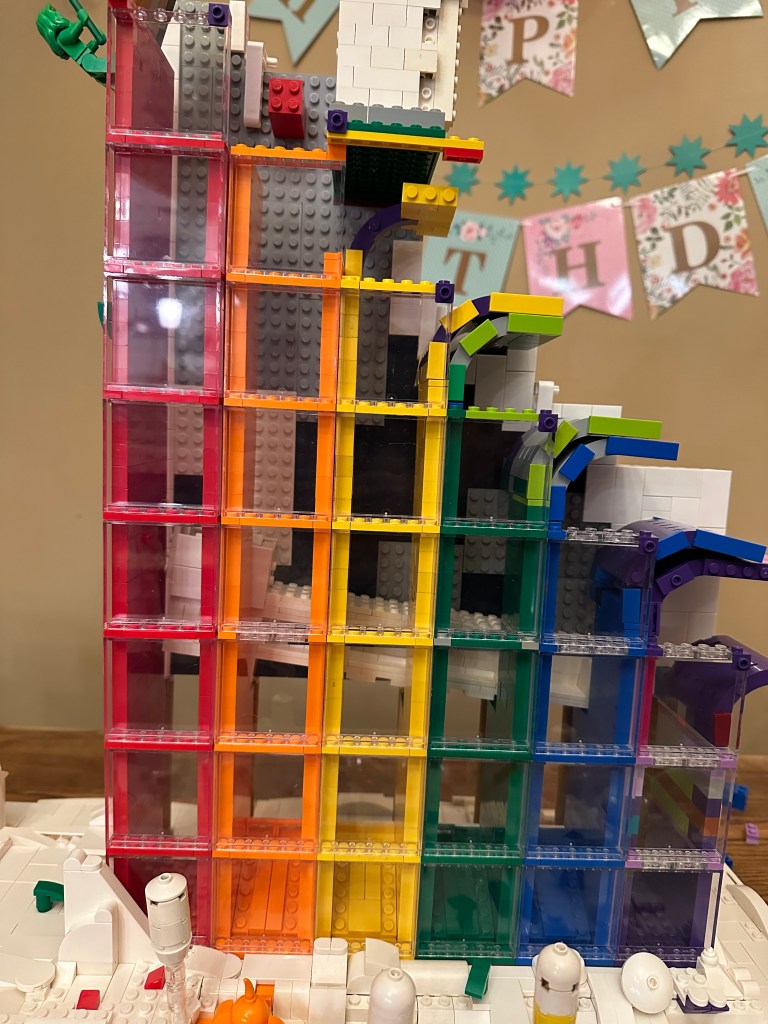
Figuring out how to make the curve on the rainbow was another matter entirely. I ended up going with something very similar to what you see above. I tried different sized curves and it soon became apparent that with the size of the build, I needed the large curve I could find. Also, you’d be surprised at to how few pieces exist in the six rainbow colors.
To connect the curved pieces (horizontally aligned) to the rest of the rainbow (vertically aligned) I added a row of 1×1 studs beneath the curves, with one of them being a technic brick with a hole in the middle. That hole attached to a singular stud in the middle of tile pieces, and that connection was firm enough to hold everything in place. Later on, once the backdrop was built, I also attached the curved to the backdrop for a few of the colors.
Here’s a better look at the coin sorter, but also the quasi-framed out rainbow. For the left colors I just used a row of bricks on their end to approximate the size. It ended up being A LOT taller than I was anticipating. About this same time I realized I had very few orange bricks, and next to no purple. Over 100000 Lego accrued over thirty years, and I had fewer than twenty purple bricks. Crazy.
The next step in the process was to figure out how I wanted to incorporate the tensegrity element. If the idea is that tensegrity gives the illusion of floating, what better to float than a cloud? But it couldn’t just be any cloud. There needed to be a reason.
This is the point where I should have considered the science of the tensegrity element, not just the coolness. I thought, you know, what if you dropped the coin on a floating cloud, which it’d roll down, then fall on another floating cloud, then plinko down to the sorter? Yeah. That’d be cool. So without additional thought, I started building.
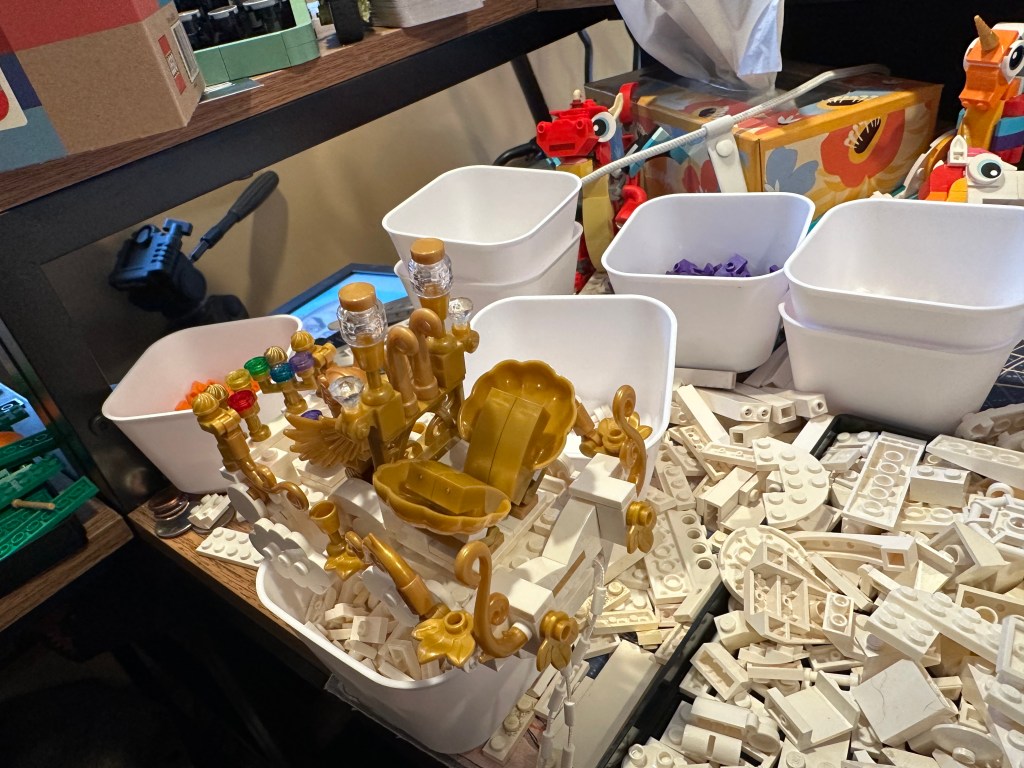
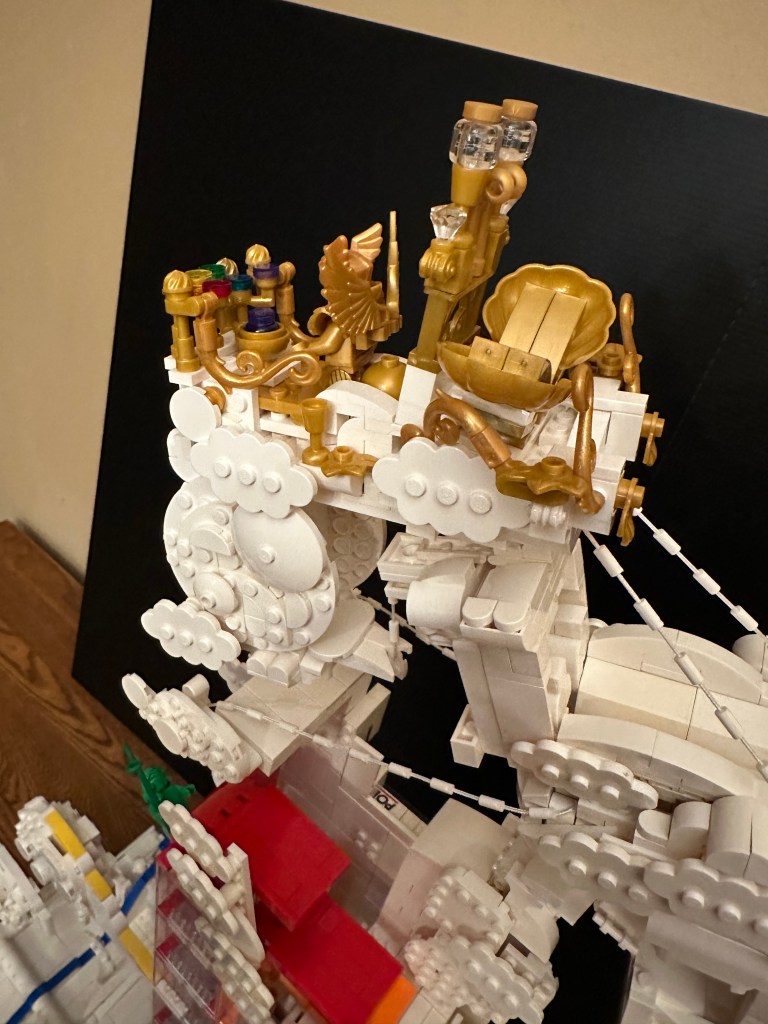
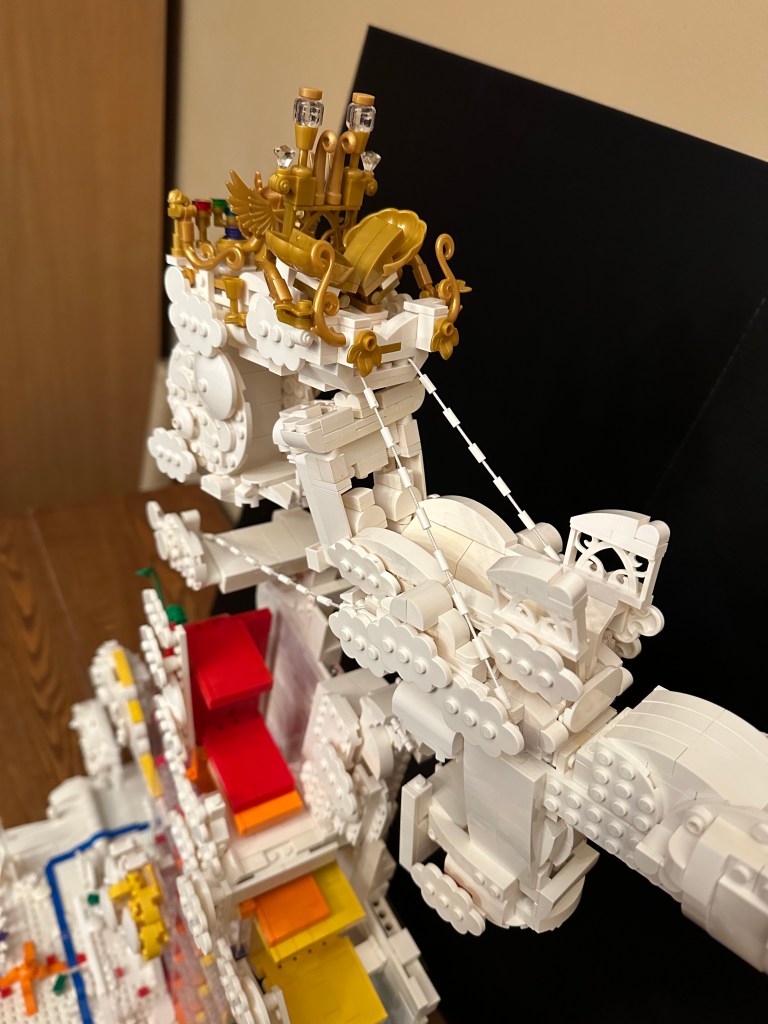
The basic idea for the story, is that this gold dude (since my kid loves gold) has decided to mess with the clouds and is unleashing the rainbow and its colors on the pristine white puffs. He’s got a supply of each color and a little cauldron to actively add a color. The clam shells behind him are where the coin will initially be set and will then roll off to the next cloud.
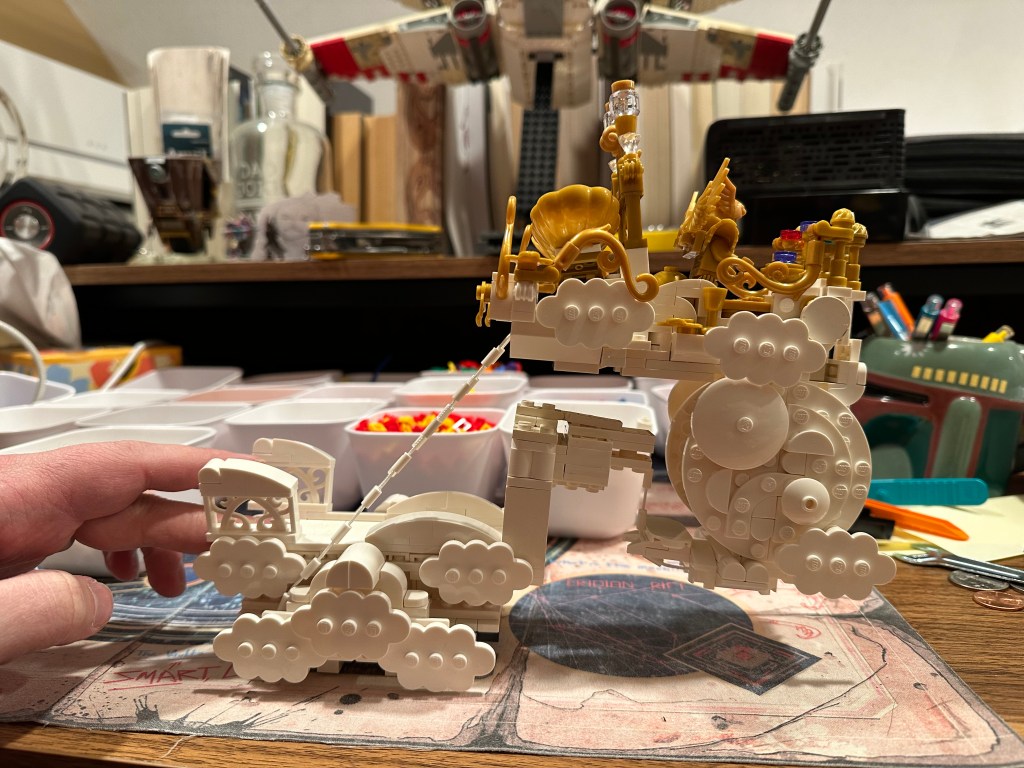
This was to be the highest elevation tensegrity element, and you can see on the bottom picture the string (Spider-Man’s webbing) hanging off the back. For this one, it wasn’t too hard to attach the string firmly, since there wasn’t a ton of weight. And now I needed some perspective.
I’ve talked on here before about having aphantasia, an inability to see images in my mind. Makes it hard to visualize a project without actually doing it. And by hard, I mean impossible. I have ideas and concepts that I can define or talk through, but until I start creating, there’s no way I can see what I’m planning. So it was time to throw things together.
A fair amount of what you see above functioned as placeholders. The “clouds” the white minifig was creating looked more like bubbles, the background was random plates, and the lower clouds looked more like mini water towers. But It allowed me to see what I working with.
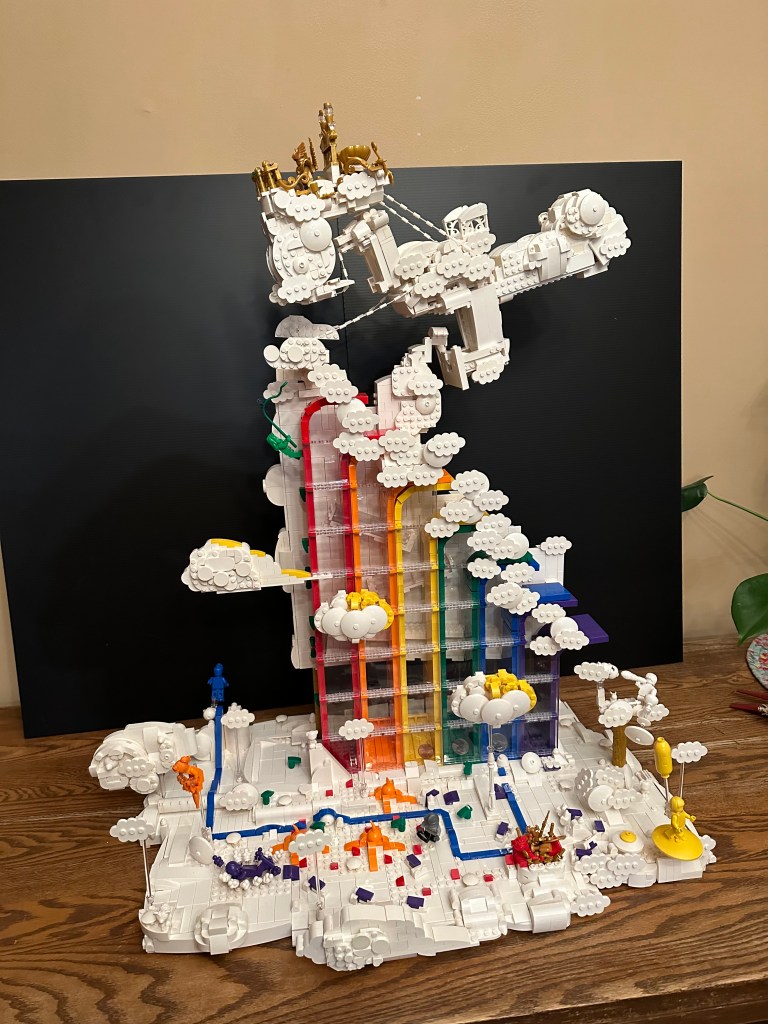
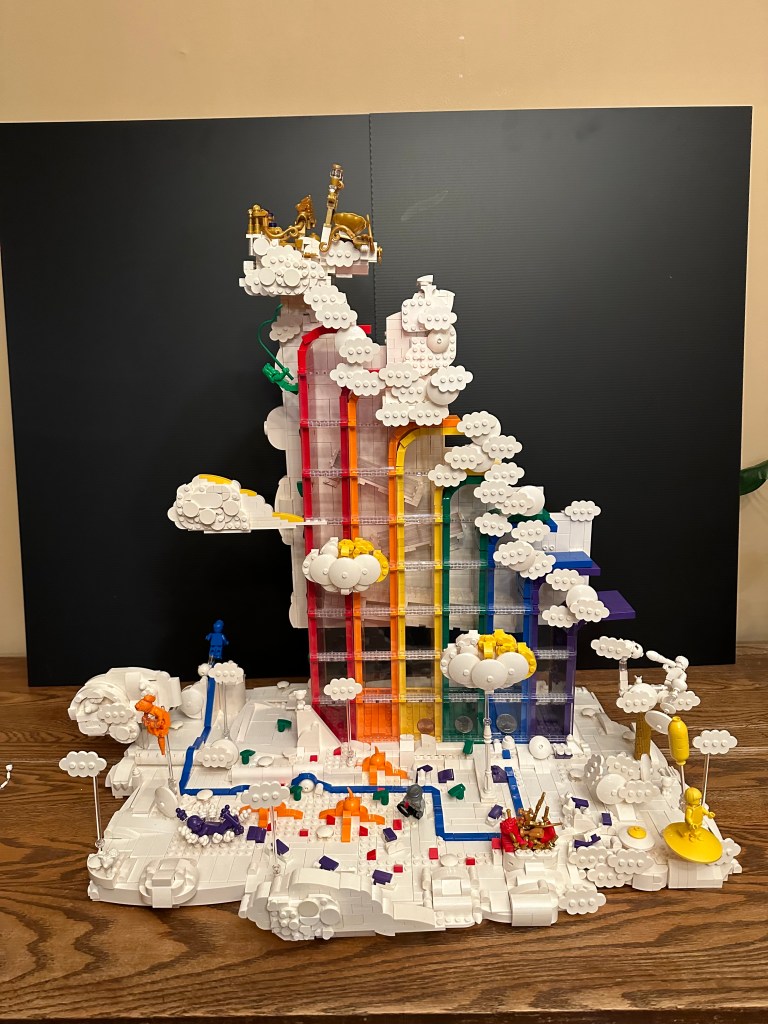
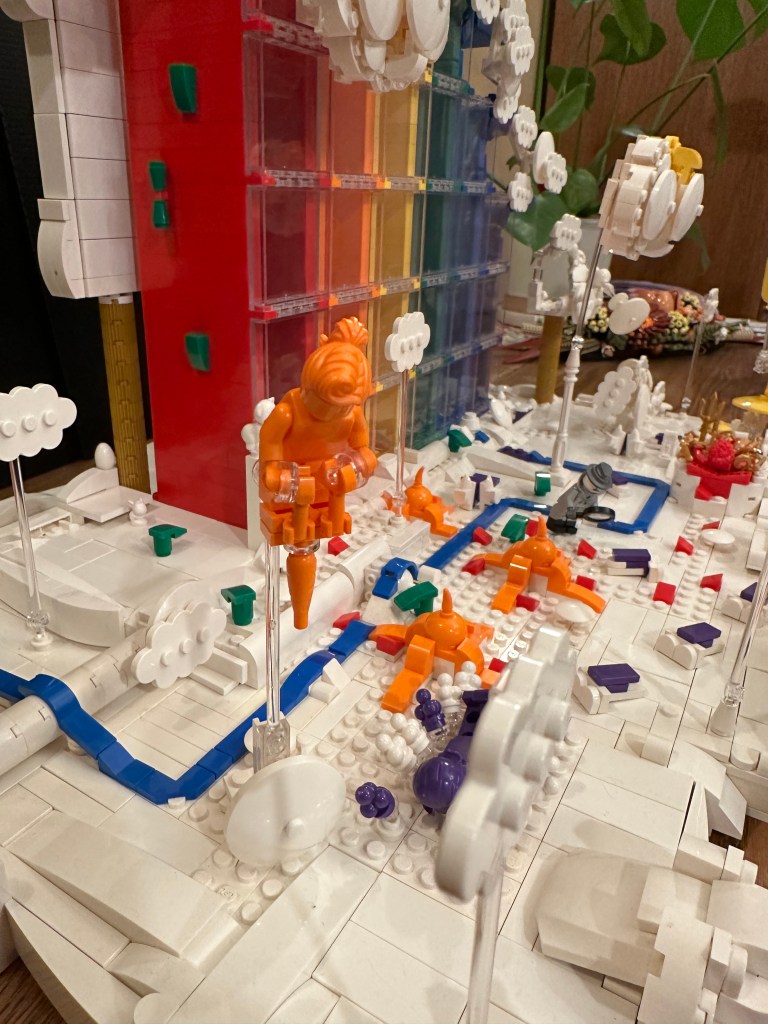
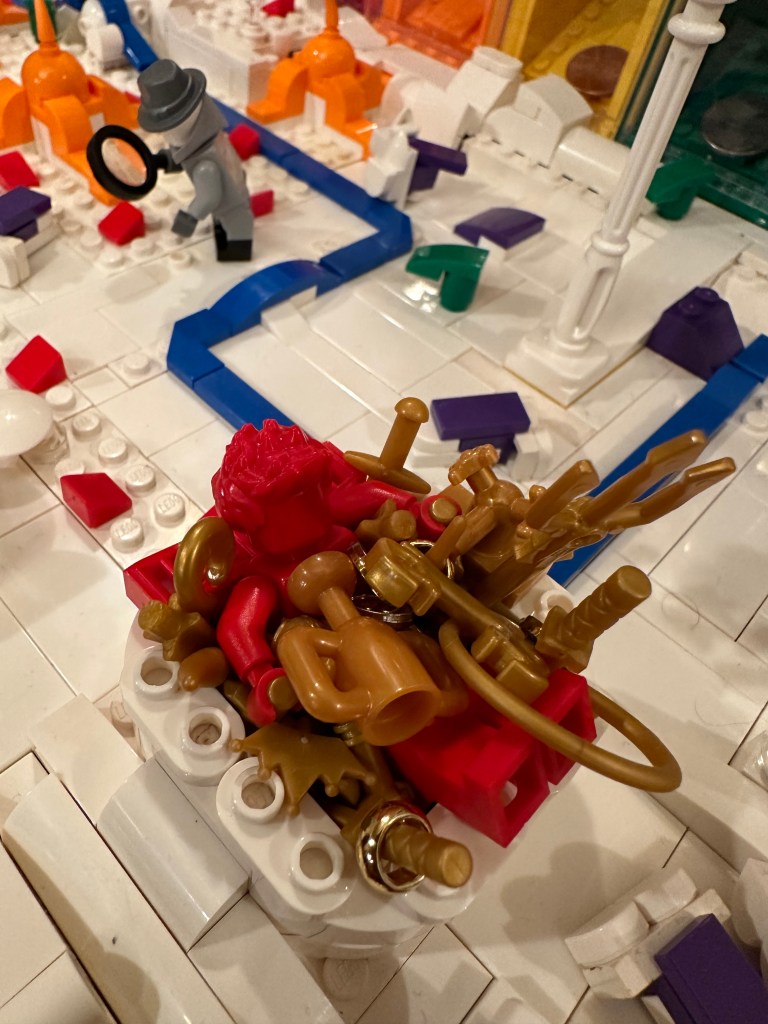
Each color had a minifig running rampant across the cloud, for which I needed a huge base in order to make it not too cluttered and busy. Red is bathing in the gold guy’s stuff, Orange is pogo sticking and leaving massive blotches of orange, Yellow is aimlessly wandering and staining the floating clouds yellow, Green is climbing the actual rainbow, Blue is skating out of control on a single skate, and Purple biffed it while skiing, making puffs of purple as she landed.
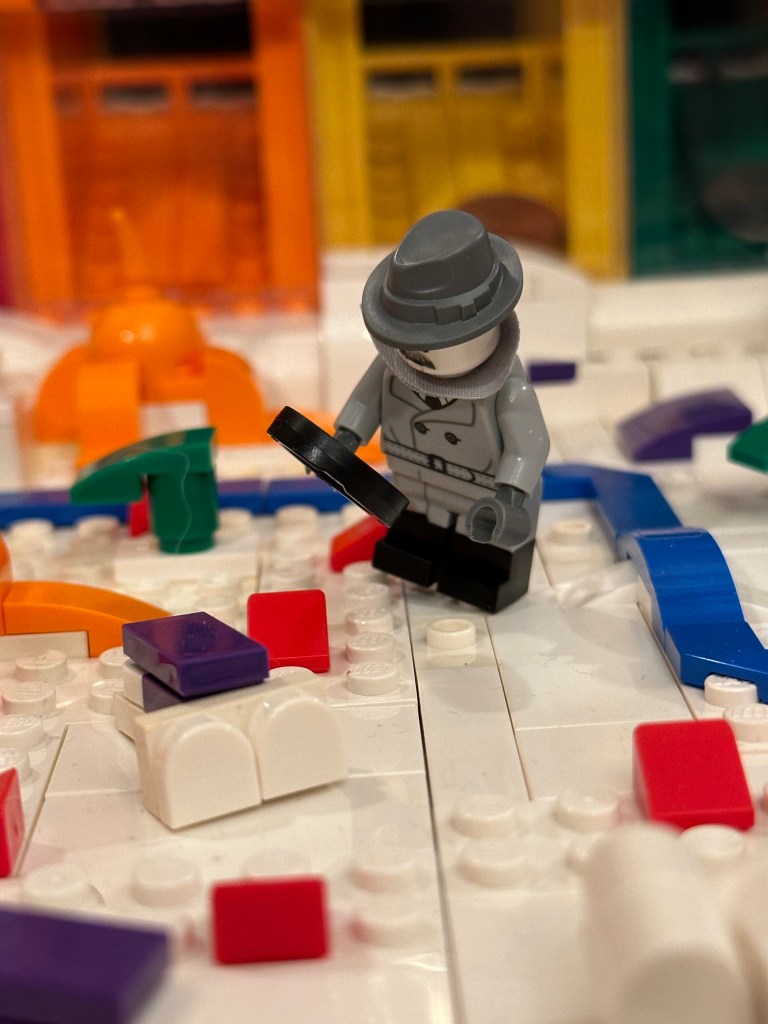
Gold watches from above, attached with transparent pieces for the time being, and the new Noir Detective is on the case, trying to figure out where all this color is coming from. White, meanwhile, the cloud native, is frantically trying to add more clouds to combat the color invasion.
The next step was figuring out how to actually attach the tensegrity cloud at the top. I had to extended it vertically downward so it could attach to something, so it got some round bulk at the bottom. And the cloud it attached to needed a channel for the coin to continue rolling down. Holding the end with my finger, it worked rather well. Just needed to make it a bit more pretty.
At least point, to my future self’s dismay, I was confident I had the tensegrity part down. No matter that I didn’t test the lower cloud balance. If the top one worked so easily, the bottom one should too. Just needed to repeat the same process. What could go wrong?
At this point the build was becoming so large I could no longer build it on my desk. I don’t have a designated Lego building space (not yet, anyway), so I had to move the whole thing to the dining room so I could access it from all sides. I lucked out and found a ton of 2×4 white tiles at the Pick a Brick wall in the Mall of America Lego Store, so I filled out the back of the cloud and added some white to the back of the rainbow. Not enough, but it was progress. I also found there the rest of the transparent windows I was using on the face of the rainbow to keep the coins from falling out.
Now, I had to buy specific parts from Brinklink. As a general rule, I don’t like buying specific parts. I like the challenge of using what’s on hand and being creative. For example, Orange’s pogo stick uses a carrot as the stick. There was probably an easier way by buying the proper orange part. But where’s the fun in that?
That being said, I needed curved pieces on the top, and they needed to be the correct color. I also needed orange and purple bricks. And more Mario clouds. A lot of Mario clouds. So I placed my order and waited.
The next step brought me a lot closer to finishing. White was no longer blowing bubbles, water towers no longer dotted the cloud, and the whole thing looked less rigid and angular. I don’t know about you, but I don’t see many angular clouds.
So what’s the next step? What’s missing? What have I been hinting would be a problem from the very beginning? You got it. Tensegrity.
I wish I had a video to show you how long it took to get that balanced. But at the same time, you don’t want to watch a forty-five minute video of me using kindergarten appropriate profanity. My goal was to have a tensegrity on top of a tensegrity. What this meant was I needed a huge counterweight on the opposite end, which you can clearly see sticks out a ton.
But this also means the who apparatus weighed a ton, so the lowest string needed to be incredibly sturdy. That was tricky. The end result, based on my goal, worked. Was it the prettiest? No. Was it a technical challenge? For sure. But, bonus prizes, the coin drop did work.
If you look closely you’ll see I added chutes to the white backdrop for the coins to roll back and forth in, and the original sort still worked as it did at the beginning of this whole project.
I decided to give the final piece two other versions, given how clunky the top of it looked with the tensegrity and how large I had to make it because of, well, physics. For one, I removed the tensegrity and modified Gold’s cloud, adding it to the top. For the other, I removed Gold entirely, for more of a clean rainbow look. I’ll let you decide which ones you like the most.
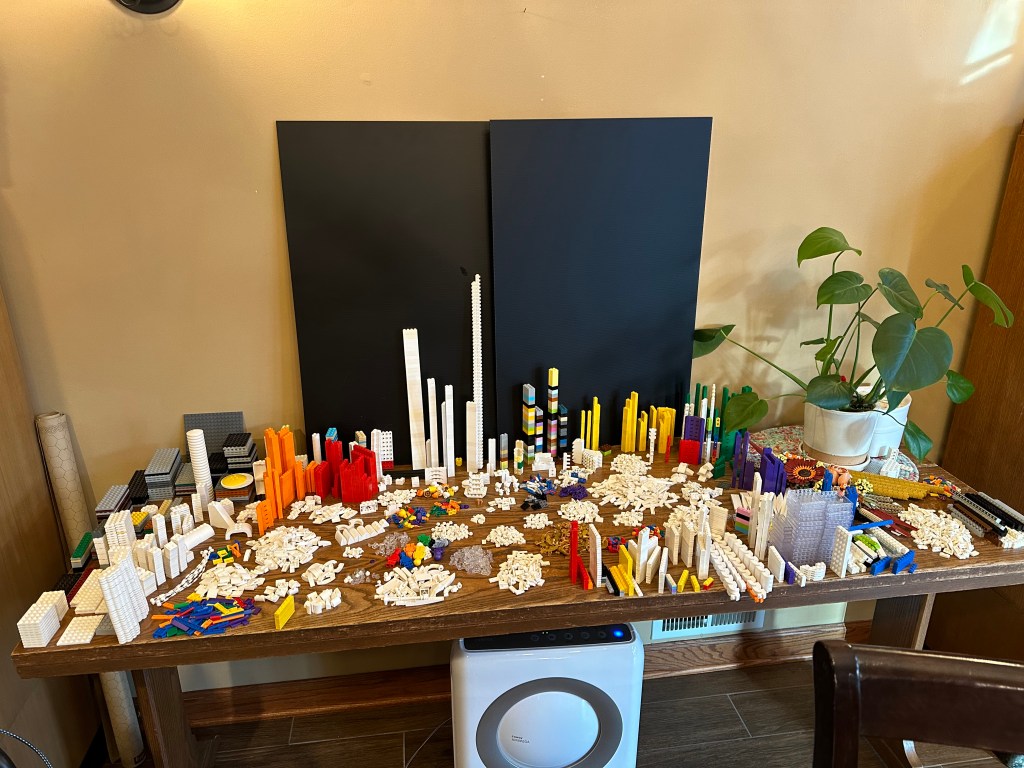
But, the build was done. Number three of five for the Lego Masters application. It was over a month from start to finish, much of the delay resulting from sorting pieces and acquiring pieces. I had so many different bins on hand of differently sorted white pieces. Several times I ran out of 1×2 and 1×4 plates as well as any and all curved white pieces, and I need to thank Roseville’s Bricks and Minifigs store for having a well-stocked bulk bin for me to pull several bags of white pieces from. I was actually there the day after completing this and almost had a PTSD episode looking at that white bin. 🙂
But what do you do when you’re done with a build? Sit there and enjoy your work? Revel in its majesty? What if your kindergartener says he loves the scavenger hunt aspect of the build and wants to tear it apart so he can make his own?
You tear it apart.
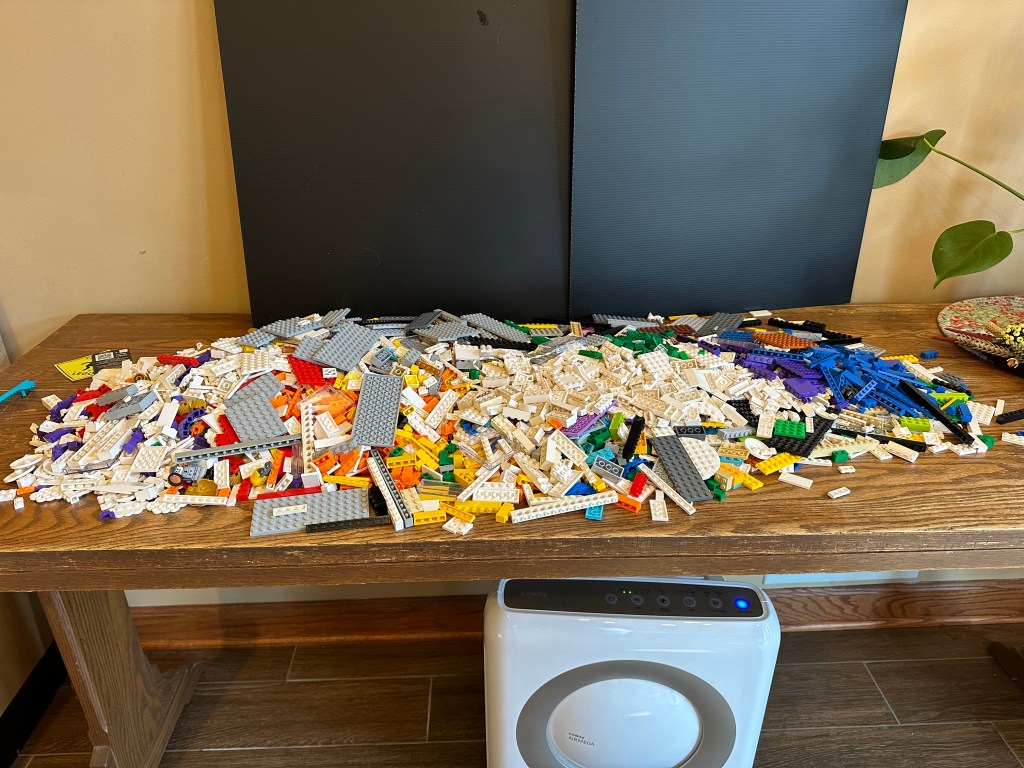
With how hard it is to keep little kids motivated, it’s surprising how focused they get when the activity is destruction. That massive pile is every piece in the build. Remember when I mentioned piece count at the beginning? Have a guess? Before I sorted and counted I said at least 2500. Technically, I wasn’t wrong…
Final piece count: 5328.
And that’s that. Ideation to construction to completion. And then destruction. Now on to the next project, one dedicated to my mom, and likely all moms out there.
Last year I went to my first AWP Conference in Seattle. Half hour to the airport, hour of security, three and a half hour flight, forty-five minute tram ride to Seattle, and a twenty minute walk to my hotel. Just over six hours from point A to B.
This year, AWP is in Kansas CIty. From Minneapolis, that’s a six and a half hour drive. About the same as last year, and cheaper too. 🙂 Bring on the Mtn. Dew and licorice (road trip staples for as long as I can remember).
Luckily, I won’t have to do the drive alone. Traveling and splitting a hotel room with writing friends makes AWP much more affordable. Plus, you all know how writers are. When they meet someone new, they either won’t say more than two words, or they won’t stop talking even as you’re walking away. Rarely any middle ground. This way I know I have reliable conversationalists.
As exciting as road trips are, the main event here is AWP. Last year I filled up my schedule, planned everything out, and realized once I was there I’d have zero time to experience the book fair. Luckily, sort of, some of my sessions filled up before I arrived, so I had a few session’s worth of time with which to visit the fair. And boy, did I need it.
If you haven’t been to the fair, it is massive. Like, two sessions might be enough time to take a cursory glance at everything. Might. If you want to make connections and actually look at what the booths have to offer, you need to devote at least three sessions. With that in mind, I kept a few sessions open this time, and if you’re going I suggest you do too.
As you’d expect for conferences, there are some sessions that are super cool, and some less so. Of course, those will depend on your preferences, and it’s a crap shoot as to how they’re allocated throughout the time blocks. Some blocks have nothing I want, others have four I really want to attend.
Barring capacity issues, the sessions I’m looking forward to the most are (and I’m only listing one per block):
Beyond the Debut: Publisher One-Night Stands vs. Long Term Relationships
Artificial Intelligence & Real Creativity: AI in the CW Classroom
What We Don’t Talk About When We Talk About (or To) Agents
Pathways to Success: Practical and Personal Tips for Getting Published
The Book Was Better… or Was It? Adapting Your Novel into a Screenplay or Play
What Authors Need to Know about Generative AI and Copyright
Crafting Unforgettable Characters—a Writer’s Guide to Storytelling
Beating the Numbers Game: Submissions Strategies
Becoming a Debut Novelist: The Journey From Book Submission to Book Launch
Down to the Wire: The Nuts and Bolts of Editing a Manuscript to Publication
From the First Idea to “It’s Finally Here!”: The Life Cycle of Publishing a Book
You can see a few themes here. I’ve a couple of manuscripts now nearing the end of their ready-to-query journey. These’ll be my first attempts, so it’s great that there are resources to lay out expectations and help me feel knowledgeable about the next phase.
I’ve also got a few AI sessions on there. Whereas I agree that AI shouldn’t be used to generate content, I don’t find it a wholly evil tool. It is just that: a tool. It’s the user that is in control of its use. I like it for research purposes. It can aggregate data and create lists far faster than I can google.
One of my favorite examples is that, for reasons, I needed a list of Shakespeare’s plays, but in order of how many people die in them. I remember trying to looked that up before AI and that I gave up because of how cumbersome it was, and set the project aside. I asked AI to do it and within seconds I had that list. Amazing.
There are a couple of one off sessions as well, but that’s the gist of my focus this year. Beyond the sessions, I’m hoping to make good contacts, perhaps future friends. I know a few writer friends going this year so hopefully between us we can find the right places and people to network.
I’ll do a post-AWP spiel this weekend, throw in a few tidbits that stood out. And I’ll probably be tweeting (is it still called tweeting if it’s not Twitter?) throughout.
As always, feel free to reach out with questions, comments, or just to say hello.
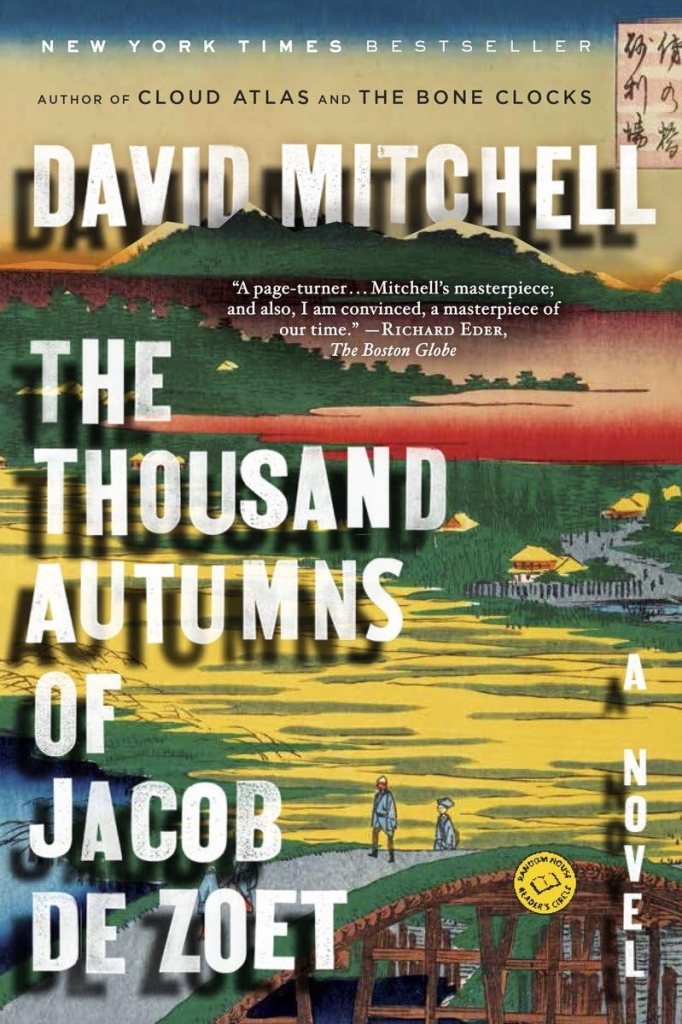
Welcome back for another book review. I want to preface this with an admission of the chance for bias. David Mitchell is one of my favorite authors, perhaps even my favorite, though it’s really hard to choose. One of my short pieces I plan to shop around once I think it’s good enough is actually about him. With favorites, there’s a tendency to overlook faults or take strengths for granted. I’ll try to do neither.
You may wonder why, if Mitchell is one of my favorites, I have not yet read The Thousand Autumns of Jacob de Zoet until now, when it’s been out for well over a decade. Circumstance and poor luck. Shortly after it came out and I acquired it, I moved. It went into one of many boxes, and most of those didn’t get unpacked for a while. By the time they did, I found a box had disappeared in the move, along with half my Mitchell books. I assumed they’d show up and then I’d finish reading it, but eventually I gave up hope and just now reacquired it.
That out of the way, let’s get to it. A spoiler-free review of The Thousand Autumns of Jacob de Zoet, by David Mitchell.
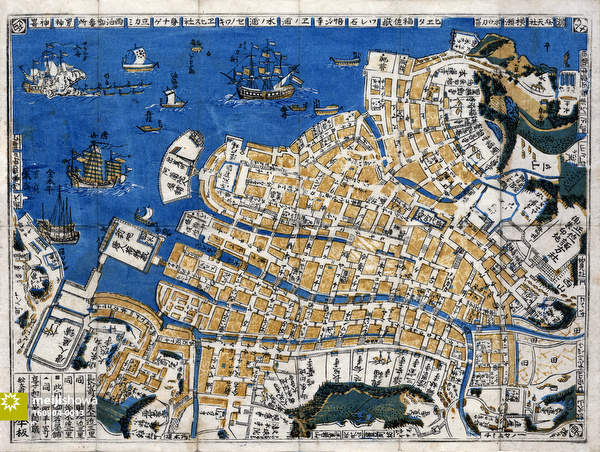
The Thousand Autumns (I’ll refer to the novel thusly to save space and prevent finger strain) follows three primary characters: titular clerk Jacob de Zoet, unlikely medical student Orito Aibagawa, and Japanese-Dutch interpreter Uzaemon Ogawa (I’ll order Japanese given and family names as we’re used to in Western culture to prevent confusion). Set in Dejima, a trading enclave in Nagasaki, Jacob is trying to make money so he can marry his betrothed back in the Netherlands. He meets Orito by chance, and Uzaemon for need of an interpreter.
Map of Nagasaki from 1801 (Kyouwa 1, 享和元年). Dejima (also: Deshima) is clearly visible in the harbor.
Printed by Yamatoya (大和屋板).
What starts off with the makings of a love story morphs into a story with ever expanding scope and the mysticism/magic you’ve come to expect in a Mitchell novel. Things are never as they seem, nor are people. More so of course than is expected anyway, as that sentiment can be applied to nearly every person or character.
Throughout the story, all the characters are faced with trials of morality and ethics. None as much as Jacob, Orito, and Uzaemon. Sometimes strong ethics serve a person well, other times they hurt. The ramifications of those choices drive the narrative as well as the whole Nagasaki region.
A few aspects I want to highlight in particular are setting, prose, and character. Let’s start with setting.
When I was in school, the foreign language I studied was Japanese. My wife also studied it, though she lived in Japan and focused more on the culture and history than I did. She read this book and said she found the setting boring because she already knew about the era and life of the Japanese and their policies regarding trade and foreigners and all the details were old news for her. What that tells me is that Mitchell has done his homework.
As a fan, I know that Mitchell has spent time in Japan as well and speaks Japanese, so it’s no surprise his knowledge of the language, culture, and history are so accurate. As someone who focused more on the language and less on the other aspects, I found the portrayal to be enlightening, the dynamics of Japan’s isolationism 200 years ago tremendously interesting and mind boggling at the same time.
There are true events woven into the story, like the attack of the British in Nagasaki, what I assume to be the Great Kaga Earthquake, and of course the warring European nations. These moments ground the reader in the reality of the world which serves to both strengthen the impact of Mitchell’s story and also highlight his unique book-to-book connections.
Moving on to prose, Mitchell was aided in that he was able to draw on Japanese symbology and propriety to help order rich, authentic words such that the sentences seemed foreign and familiar all at once. I noticed in particular a tactic of interspersing descriptions of setting between spoken words and actions that I don’t recall in his other writing, and that’s having just read Utopia Avenue a few months ago.
I haven’t the audacity, nor experience, to try and accurately portray another living culture’s mannerisms speech patterns, and when Mitchell does so in The Thousand Autumns, I never felt for once that he was stereotyping or using unusual vocal patterns as an interesting crutch, relying on the foreign sounds or diction to engage the reader. When Orito or Uzaemon spoke, their words read authentic and true, which is no small task. That holds true with their thoughts as well.
Lastly, before I go into craft, I want to mention a brief thought on my reactions to character. Talk to anyone who knows me, and they’ll tell you I’m not outwardly emotional, perhaps bordering on sociopathic. That’s a bit of an exaggeration, but the point I’m trying to make is that I’m rarely emotionally responsive. For me to react emotionally to a book says something about its efficacy. (Unless we’re talking about rage quitting. Non-effective storytelling there. I’m looking at you Ready Player One)
There’s a moment, and I’m being vague to avoid spoilers, where Jacob has to say goodbye to someone. I got choked up. Like, tight throat, sniffles, the whole shebang. The moment wasn’t an overly dramatic profession of love, or a heart wrenching death of a beloved character, but a simple goodbye. The reaction this moment elicited could only have been achieved through solid portrayal, and thus investment from me, of the character Jacob.
Okay, on to craft talk. Today’s topic: Research.
I touched on this earlier in setting, but wanted to expand beyond the scope of The Thousand Autumns. I can think of few exceptions where research would not be necessary for a novel. I’m sure Neil Gaiman had to dig through tons of myths and religions when he wrote American Gods. Or Cherie Priest had to find maps and records of 1880s Seattle for her Boneshaker books. Research lends credibility to a story, but it also grounds the reader in the world.
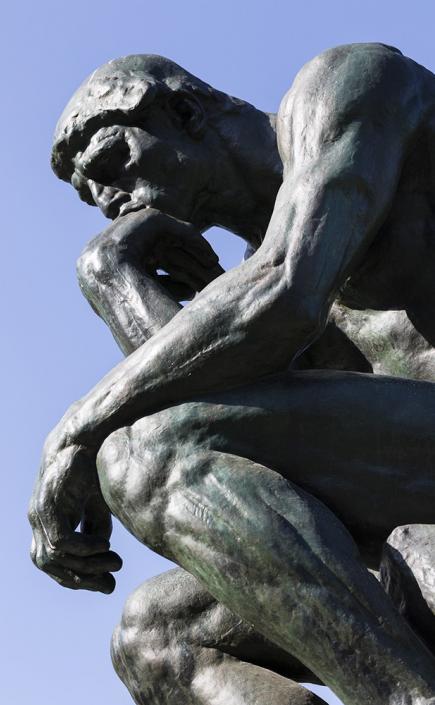
Imagine you’ve picked up DaVinci Code and you’re following Robert Langdon through the Louvre and Dan Brown throws in something about racing past Rodin’s The Thinker on his way to the Mona Lisa. Dan Brown is pretty sure The Thinker is in Paris, and the Louvre has all the cool stuff, so it’s probably there. Spoiler: It’s not. It is in Paris, but it’s at Museé Rodin, not the Louvre.
The magic of DaVinci Code is all the research that makes the story, the interconnected bits of history, engaging the reader with history. Every place Langdon visits is real. I actually have an annotated copy of the book complete with photos and illustrations of the sites and pieces of art. Few people will know every art and history reference in the book, but having that information there raised the reading experience to a whole new level.
Research gives validity to the world of your story. And it doesn’t matter if your world is Earth or Mars or Xanth or something I’ve never heard of. Sometimes research it just finding the proper details. I’m working on a story where the protagonist is a carpenter and I had to learn how to build a chair with medieval era tools. I already knew how to with modern tools, but I can’t exactly have my character whip out a cordless drill. Or there was the story of mine just published in Space Brides. Exactly how bright is Jupiter if you’re standing on Europa? How far does that elevator ride through the ice need to be? Research.
I know sometimes research may seem like a slog, that every page you get to poses a new question that interrupts your flow. One trick is to throw a placeholder in so you can keep writing and do the research later. For months I had “HE BUILDS A CHAIR” followed by the rest of the scene. Another is simply read a ton about what your character knows or experiences before you write and you can just go with it. Or, if you’re David Mitchell, go live in Japan for a decade. To each their own. 🙂
I can’t really give advice as to how to best do research. That depends on you and your story. But I can’t stress enough the importance of it. We’ve all heard of the seven basic plots that all stories follow. What separates those stories from one another are the details. We get those details from research. Details enrich the reading experience and color your worlds. Find those details. Do the research.
Now, time to break out the Author’s Arsenal and throw some accolades at The Thousand Autumns of Jacob de Zoet.
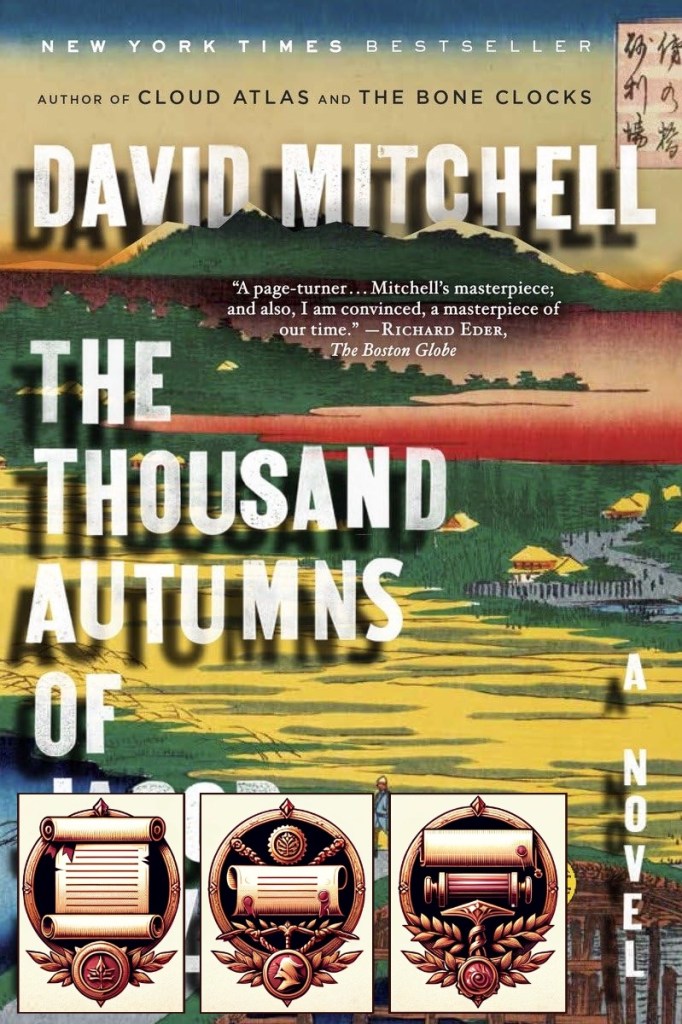
For accurate linguistic depictions and line to line pacing, I award The Parchment. For making me emotional and balancing culture with agenda, I award The Seal. And for the research, for bringing an accurate (of course accounting for factionalized elements) world of turn of the 19th century Japan to his readers, I award The Scroll.
For those who have not read David Mitchell, these awards should not be surprising. His novels are regularly long and short listed for awards, and the varied settings and times they take place in always present something new. My first exposure to him was Cloud Atlas. It is my favorite book of all time. Just phenomenal. But, if you’re thinking about reading The Thousand Autumns of Jacob de Zoet, don’t. At least, not first.
I needed to put in here somewhere that most of his novels are loosely (some not so loosely) connected. You technically could read them in any order, but I think what makes the most sense (and my google search confirms my thoughts) is that you should read them in order of publication. That would mean Ghostwritten, number9dream, Cloud Atlas, Black Swan Green, The Thousand Autumns of Jacob de Zoet, The Bone Clocks, Slade House, and Utopia Avenue. For me, the weak link was Black Swan Green, but I know those who really enjoyed it.
Hopefully this review will have made a new Mitchell fan or two. Until next time, happy reading, and if you have any books you’d like me to read and review, let me know.
I finished up 2023 with 55 books read, beating my Goodreads challenge by five books. Averaging just over a book a week, it occurred to me that there is plenty of opportunity to talk about books and what I, and perhaps you, are reading.
The next thing I wanted to decide on was how to talk about the books and how to value them, as a review generally is supposed to do. How to talk about them was the tricky part, but after conversations on twitter as well as in real life, I’m going to pick something from the book that either stood out as effective or ineffective, and do a spoiler-free analysis of that particular literary technique (because everyone hates spoilers).
Valuing the book seems trickier. You can find a something-out-of-five rating on Goodreads easily enough, but I wanted something more personal, and something more informational. What does a star mean? What’s the difference between three and four? Between four and five? Did the fantasy have too little magic? Was the romance too overt? Did I figure out the mystery’s killer in the first ten pages? I read a lot of different stuff, so I need something that can accommodate different types of books. I hereby give you…
The Author’s Arsenal system.
By no means are these five areas exhaustive, but they represent five key elements in any story. By not awarding a book with one of these emblems, it doesn’t necessarily mean it did poorly (though it very well could). Instead the emblems it does receive should be lauded as the book’s strength. The five emblems are:
The Quill Pen. This will be awarded for exceptional storytelling or narrative.
The Inkwell. For depth and richness of theme.
The Parchment: For the quality of writing style and prose.
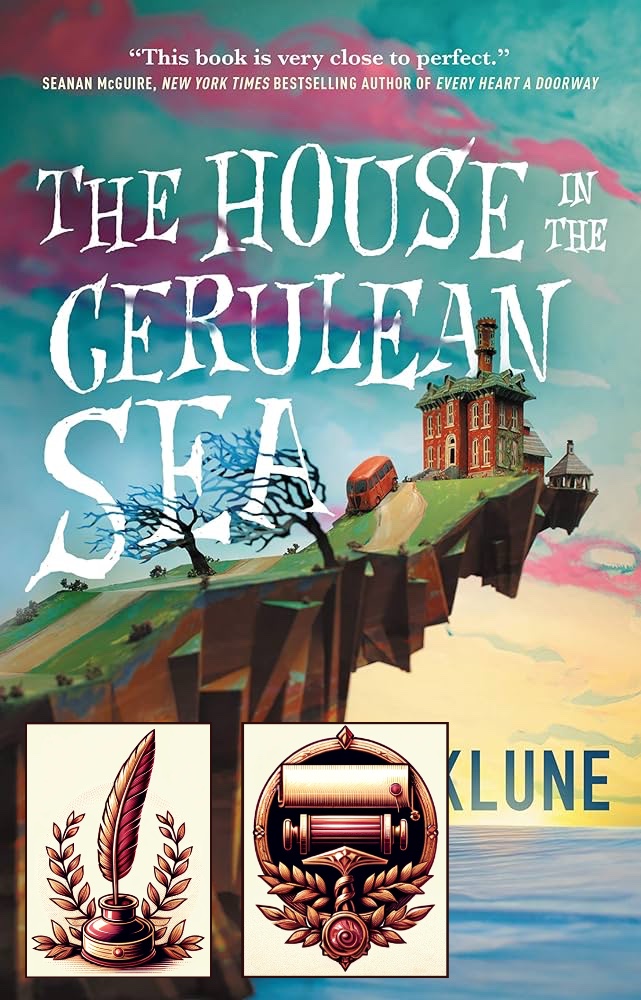
T.J. Klune’s magical realism novel treads the line between middle grade and YA. It’s longer than a typical middle grade book, however the language fits a middle grade book style much more closely than it does YA. The prose is direct, the characters are clear with their feelings, and everything feels very honest.
As I finished my read, two things stood out. First, the world-building. The House in the Cerulean Sea features an alternate version of our world where magical creatures/children exist and are known by the general populace. Linus, our main protagonist, is sort of a social worker for these children, and the whole story revolves around a specific assignment he must complete.
From the inner-workings of the bureaucratic government oversight agency to the prejudice of humans toward magical children to the intricacies of the various environments, Klune does a great job of establishing a believable world the characters exist in. Often times middle grade stories can gloss over details or dive too deep at the expense of narrative and character, but he does a fine job of maintaining the correct balance.
The second highlight is theme. It is established early on—so I don’t consider this a spoiler—that Linus is a gay man. There’s no fanfare in the revelation, and no shame. It is was it is. Which is exactly how it should be. Linus exists in a world where he expects to be treated the same as everyone else, and believes that others have the same right. Including magical children. Between him wrestling with his own emotions as well as understanding and accepting the children, Klune does a fantastic job of establishing and reinforcing a positive theme with enough tact and honesty for a middle-grade (and older) audience to understand the message without feeling they are being beaten over the head.
Before I move on to my craft bit, I do want to call out the one thing that rises above the rest in this book. Written as a middle grade book, there are expectations and limitations when it comes to prose. A third grader typically won’t be able to handle Tolstoy or Faulkner. The prose must accommodate the audience. But that isn’t necessarily a summation of the author’s ability. While most of the book reads as typical middle grade prose, there is a poem around the midway point that, while plain in diction, is rich in metaphor and layered with emotion. After I finished it I audibly said “dang.” If you pick up this book, that is definitely something to look forward to.
On to craft. Since finishing this book, I’ve had many discussions about it, some with people who haven’t read it (mainly on the function of craft), and some who have (mainly on the application of craft). Based on those conversations, today’s topic is agency.
I’m sure most of us are familiar with the term, but agency basically describes the character’s ability to do something. Are they reacting to events and being led by the nose, or are their reactions to the events of the story their own choice, plot and antagonists be damned. There is a distinction to be made about their choice.
If the character gets into a situation where they must do something or face terrible consequences, sure, they’re technically choosing to do the thing, but that’s not much of a choice. They’re basically being herded. But, if they’re presented with that same choice and do a third option, or they agree and turn that choice into their own growth, then you’ve got some agency.
Sometimes the decisions are small. Deciding not to answer that phone. Turning left when they always turn right. Maybe this one time they’ll skip the coffee shop on the way to work. Sometimes the decisions are larger. Standing up to the bully. Giving into temptation and stealing that heirloom. Turning off the targeting system as they fly through the trench.
What makes characters interesting is their choices, and their ability to choose. It makes their lives more dynamic, makes their actions carry more weight, and it adds a pulse to the story, an energy the reader can feel even if they’re unaware that’s what they’re feeling. You can have an amazing plot and setting, but if you have a boring character sleepwalking through that story your readers won’t connect.
In The House in the Cerulean Sea, Klune uses a tried and true character arc of a person lacking agency, only to gain it as the story advances. That arc can be tricky. If you wait too long to have the character begin to learn, you may lose your reader. Often times those characters will be supported by interesting plot, immersive world-building, or engaging prose. If you can hook the reader long enough to ascend that arc, then good on you. But without a character to invest in, pretty words and locations can only do so much.
And now, for the big moment, how did The House in the Cerulean Sea fare with the Author’s Arsenal?
For deftness of theme and a well-execute message, especially given the audience age, I award The Inkwell. For an immersive (and wholly believable) world, I award The Scroll.
Remember, for awards not received, it doesn’t indicate a poor execution of those qualities. The awarded emblems are just for what is done particularly well.
I’m sure this is the most prestigious award the book has received 😉 As such, Klune should be proud of the world, characters, and story he created.
Future reviews won’t have the whole explanation of the review process. This one did because it was the Arsenal’s maiden voyage. Expect a variety of books, new and old, across genres. And, if you have any you’d like to recommend, let me know. If I’ve already read the book, the odds are low I’ll review it. I rarely re-read anything because there’s just so much out there and I want to get as much new content as possible.


















 The Quill Pen. This will be awarded for exceptional storytelling or narrative.
 The Inkwell. For depth and richness of theme.
 The Parchment: For the quality of writing style and prose.
 The Seal. For character development.
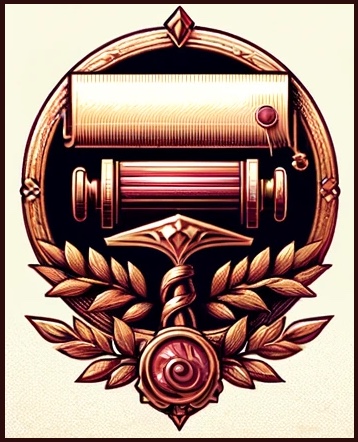 The Scroll. For world-building and setting.
 Eric Taveren